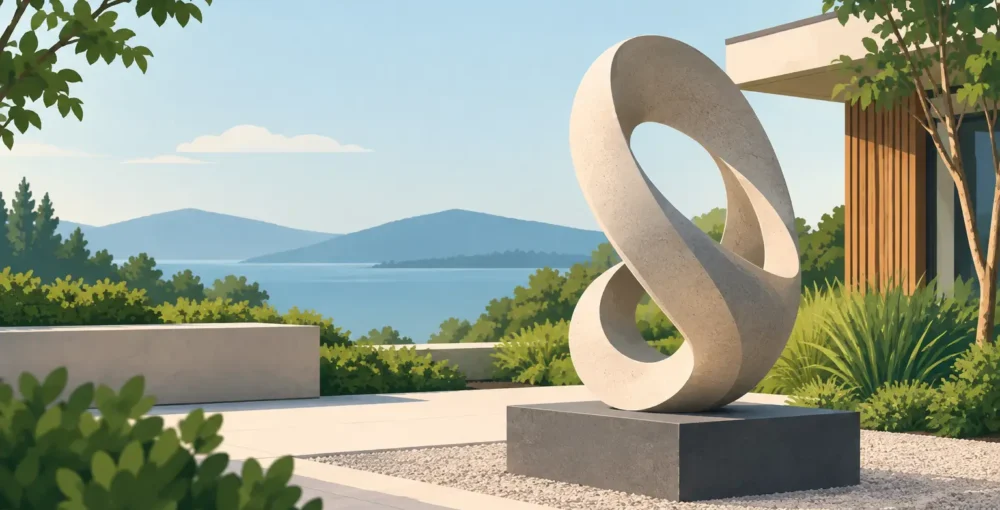
A terrace can be finished with beautiful stone, mature planting, and considered lighting, yet still feel incomplete. What it often lacks is a singular object with enough presence to hold the eye and give the setting a center of gravity. This outdoor sculptural design review considers what separates a merely decorative garden object from a lasting design artifact: one that belongs to the architecture, develops character in the open air, and rewards attention over decades.
For private residences, boutique hospitality settings, and landscape schemes with architectural ambition, sculpture outdoors is not an accessory. It is a spatial decision. Its silhouette affects the view from inside; its surface changes the mood of a courtyard; its scale can make an expansive lawn feel intentional rather than vacant. The right piece establishes a dialogue between built form, terrain, water, planting, and sky.
What Outdoor Sculpture Must Accomplish
An exterior object carries a more demanding role than one placed in a controlled interior. It must remain compelling under sharp noon light, at dusk, in rain, and through the softer visual compression of winter. It must feel persuasive from a distance while revealing a more intimate language of material and handwork at close range.
The strongest works do not compete with the landscape through unnecessary complexity. Instead, they create tension through proportion. A low, elongated volume can draw the eye along a reflecting pool or frame the horizon beyond a terrace. A tall vertical form can give rhythm to a broad garden axis. An object with a curved, organic profile may soften severe architecture, particularly where glass, travertine, or concrete define a residence with strong linear order.
This is why scale cannot be judged from a studio image alone. A sculptural bench may appear monumental in a photograph yet disappear against mature hedging. Conversely, an imposing monolith can feel unexpectedly refined when positioned at the end of a long approach. The measure is not simply size. It is visual weight, negative space, and the relationship between the object and the distances from which it will be seen.
Outdoor Sculptural Design Review: Form Before Ornament
A considered outdoor sculptural design review begins with form, because form endures when surface decoration loses relevance. The most convincing pieces possess a clear silhouette that can be recognized in shadow. They resist the impulse to explain themselves immediately.
Curved forms are especially powerful outside because nature already works through gradual transitions: the bend of a branch, the worn edge of stone, the contour of a hill. This does not mean a sculpture should imitate nature. Literal botanical motifs often reduce a piece to ornament. The more sophisticated approach is abstraction, where an organic gesture is distilled into a confident volume, a recessed line, or a sensuous interruption in an otherwise calm mass.
Material should amplify that gesture. A hand-finished metal can introduce depth through its changing reflections. Carved stone lends permanence and quiet density. Advanced composite surfaces may permit continuous, fluid volumes that would be difficult to achieve through conventional fabrication. Each choice has consequences. Mirror-polished metal can create extraordinary drama near water or dense greenery, but it demands a precise setting and a tolerance for visible environmental change. Pale stone offers serenity, though it may require careful attention to staining, drainage, and the local climate.
The question is not which material is universally best. It is which material allows the intended form to age with dignity in its particular location.
The Value of Patina
Patina is often misunderstood as evidence of decline. In exceptional exterior design, it is part of the work’s life. Rain may deepen the tone of stone. Sun can soften a surface’s initial uniformity. Oxidation can bring unexpected complexity to selected metals. These changes should be anticipated at the design stage, not treated as a later inconvenience.
There is a distinction between patina and neglect. A fine outdoor piece should develop a richer visual record without losing structural integrity or becoming difficult to maintain. The finish, joints, drainage details, and installation method must be resolved with the same rigor as the visible form. True luxury is not fragility disguised as rarity. It is the assurance that an extraordinary object has been made to inhabit its environment with confidence.
Placement Is Part of the Design
Even an exceptional object can lose its authority through indifferent placement. A sculpture placed against an overly busy backdrop becomes visual noise. One set too close to a path may feel like an obstacle rather than an encounter. The most memorable installations understand approach, pause, and reveal.
At the entrance to a residence, sculpture should set the emotional register without overwhelming arrival. It may be seen first from a vehicle, then from the threshold, then at close range as guests pass it. This sequence favors forms with a strong distant profile and a tactile surface vocabulary.
In a courtyard, the object often becomes the central event. Here, restraint is essential. A single sculptural presence, supported by generous negative space and restrained planting, is generally more powerful than a collection of disconnected pieces. In larger grounds, the landscape can accommodate a slower experience: a work discovered beyond a clipped hedge, reflected in water, or positioned to capture the final light across an open view.
Exterior rooms demand a slightly different approach. On a covered terrace or beside an outdoor dining setting, sculptural furniture can erase the conventional boundary between object and utility. A seat, console, fire element, or freestanding volume may perform a practical function while retaining the authority of collectible design. The challenge is to preserve clarity. When every furnishing makes a statement, none of them does.
Commissioning Beyond the Catalog
For collectors and architects, bespoke work offers an opportunity that standard outdoor collections rarely provide: the ability to shape an object around a precise spatial and emotional brief. This might begin with the architecture’s geometry, a landscape architect’s planting rhythm, a rare stone already used in the project, or an instinctive desire for a particular atmosphere.
A successful commission should not be understood as a request to apply a different finish to an existing model. It is a process of translation. Dimensions are calibrated to sightlines. Materials are chosen for their response to weather and their relationship to adjacent finishes. The object is developed around the reality of the site, including access, foundations, drainage, exposure, and the privacy expected of a significant residence.
That level of control matters. Cedrimartini approaches exterior pieces through the combined disciplines of design atelier and maker, allowing sculptural intent, material research, and fabrication to remain closely held from concept through final realization. For clients who value discretion, this internal continuity is as meaningful as the object itself.
The Questions Worth Asking Before Acquisition
Before selecting or commissioning an exterior sculptural object, it is worth asking whether the work has enough formal strength to stand in changing conditions. Ask how its material will respond to direct sun, freeze-thaw cycles, salt air, or high humidity. Ask where water will travel across and beneath it, and whether its finish is intended to evolve.
It is equally useful to ask what the piece contributes to the larger composition. Does it anchor a view? Does it create a moment of contrast against architecture? Does it invite use, contemplation, or movement through the landscape? If the answer is only that it fills an empty area, the selection has not yet reached the necessary level of intention.
Provenance and fabrication also deserve attention. Limited-edition and one-of-a-kind works carry greater significance when the hand of the maker, the origin of materials, and the discipline behind the construction are clear. In luxury environments, authenticity is perceived not through excess branding but through resolution: a flawless curve, a deliberate junction, an uncommon finish, and the quiet certainty that the work could not have been made by accident.
A Lasting Presence in the Open Air
The finest outdoor sculpture does not merely survive outside. It becomes more itself there. Light reveals new contours, weather gives the surface a more complex voice, and the surrounding landscape supplies a changing frame that no interior can replicate.
Choose a piece that asks something of the setting and gives something back to it. When form, material, and placement are resolved as one gesture, an exterior space gains more than an object of beauty. It gains a presence that makes the entire property feel more singular.