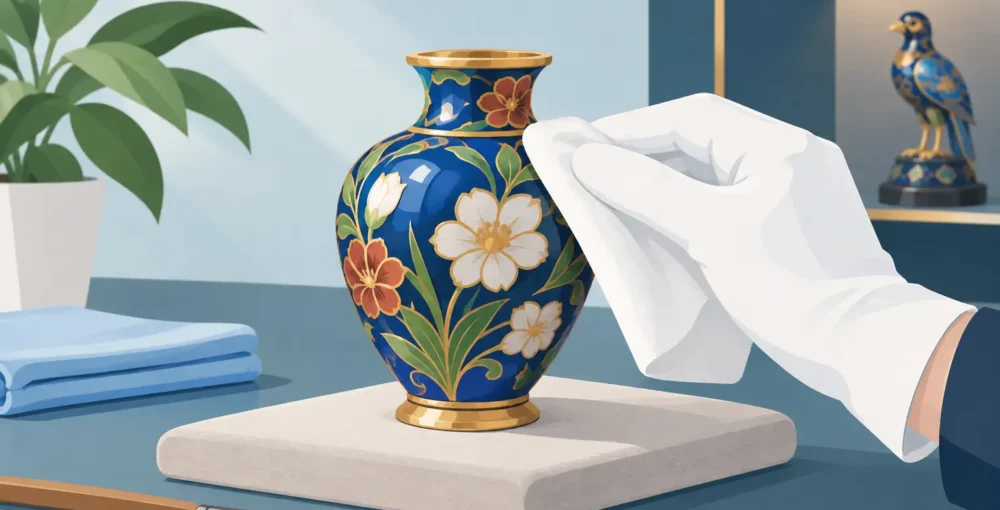
A luminous enamel surface changes the atmosphere of a room before one has fully registered its form. It may hold a saturated field of color, a deep mineral gloss, or a finely worked irregularity that only reveals itself in changing light. Preserving enamel finishes is therefore not simply a matter of keeping an object clean. It is the careful protection of a visual language shaped by heat, handwork, and time.
For collectible furniture and sculptural objects, enamel deserves the same considered stewardship as stone, patinated metal, or hand-finished wood. Its beauty is often inseparable from its delicacy. A confident approach begins not with a cleaning product, but with an understanding of what the surface is and how the piece lives within its setting.
Why Enamel Requires a Different Kind of Care
The word enamel can describe more than one finish. Vitreous enamel is a glass-based coating fused to metal at high temperatures. It has exceptional depth and permanence, yet can chip or craze when subjected to impact or abrupt thermal change. In furniture, lighting, and interior objects, the term may also refer to a layered decorative finish with a lacquered or resinous character. This can be extraordinarily tactile and visually complex, but more vulnerable to solvents, abrasion, and prolonged heat.
These distinctions matter. A method that is harmless for one surface can permanently dull, mark, or soften another. Before any intervention, establish the nature of the enamel, its substrate, its age, and whether it has been sealed or restored previously. For a commissioned piece, the atelier’s care guidance should always take precedence over general advice.
The allure of enamel is its apparent stillness. In reality, it responds to its environment. A highly polished surface records fingerprints and fine dust more visibly than a matte one. A richly pigmented finish can be altered by persistent ultraviolet exposure. An object used daily at a vanity, dining table, or bath setting will need a different rhythm of care from a sculptural vessel admired at a distance.
Preserving Enamel Finishes Through Placement
Placement is the first and most elegant act of conservation. The right location protects the work without making it feel untouchable.
Avoid positioning enamel-faced furniture or objects where direct, sustained sunlight falls across the same area every day. Sunlight is not always immediately destructive, but years of exposure can alter certain pigments and create uneven aging between exposed and shaded areas. Sheer window treatments, thoughtful orientation, and controlled lighting preserve visual consistency while allowing the finish to retain its presence.
Heat deserves equal consideration. Do not place hot vessels, styling tools, candles, or warming appliances directly on an enamel surface unless it was expressly designed for that use. Even where no visible mark appears at first, localized heat can stress the surface or affect adjacent materials, adhesives, and pigments. Use a soft, stable intermediary beneath objects that generate heat or condensation.
Humidity calls for judgment rather than anxiety. A well-made enamel finish can perform beautifully in a properly ventilated bath or spa environment, but persistent steam, standing water, and poor ventilation introduce unnecessary risk. In coastal residences, exterior installations, and wellness spaces, the interaction between enamel, metal edges, hardware, and neighboring materials should be considered as a whole. The finish may be stable while an untreated junction is not.
For pieces with drawers, doors, or articulated elements, leave enough clearance to prevent contact with hard architectural surfaces. A single repeated strike against stone, metal, or a projecting handle can create the kind of edge damage that no routine maintenance can prevent.
The Right Way to Clean an Enamel Surface
The most sophisticated maintenance is restrained. Dust should be removed regularly with a clean, soft microfiber cloth reserved for that purpose. This prevents airborne particles from becoming a fine abrasive film, particularly on horizontal planes and high-gloss finishes.
When more than dry dusting is needed, use a second soft cloth lightly dampened with clean water. Wring it thoroughly before contact. The aim is to lift residue, not saturate the surface or allow moisture to gather at seams, corners, or metal transitions. Follow immediately with a dry, nonabrasive cloth, using minimal pressure.
For an isolated fingerprint or light spill, a small amount of mild, pH-neutral soap diluted in water may be appropriate, provided the finish has been identified and the method has been tested discreetly first. Apply the solution to the cloth, never directly to the object. Wipe gently, then remove any remaining soap film with a separate damp cloth and dry the area fully.
Household shortcuts are rarely appropriate for collectible surfaces. Avoid scouring powders, cream cleaners, abrasive sponges, bleach, acetone, alcohol-based sprays, vinegar, ammonia, and conventional furniture polish. These products may leave a haze, alter the gloss level, compromise a protective layer, or deposit residue that attracts further dust. A product advertised as gentle is not automatically suitable for a hand-finished enamel surface.
The same caution applies to fragrance diffusers, cosmetics, hair products, and colored liquids. These are often more problematic than a measured cleaning routine. If a spill occurs, blot it promptly with a soft dry cloth, then assess rather than rub. Pressure and repetition can enlarge a small blemish or carry pigment into a micro-fissure.
Touch, Use, and the Value of Patina
Luxury should be lived with, but every finish establishes its own terms of use. A hand-applied enamel top intended as a dramatic occasional table can welcome careful use with coasters and felted objects. A wall-mounted sculptural panel needs protection from incidental contact, bags, keys, and moving furniture. The distinction is not preciousness for its own sake. It is respect for the surface’s intended role.
Protective pads beneath decorative objects should be clean, colorfast, and replaced periodically. Old felt can trap grit; rubber pads can sometimes transfer or react with a finish over time. Avoid sliding objects across enamel, even lightweight ones. Lift, place, and adjust deliberately.
Not every mark is a failure. In handmade work, slight variations in gloss, subtle movement within the color, or minute evidence of the making process are often integral to the piece. Attempting to make such character disappear can flatten what gives the object authority. Preservation is not the pursuit of sterile perfection. It is the preservation of intention.
There is, however, a meaningful difference between authentic character and active deterioration. New chips, lifting edges, unexplained clouding, cracks, or a sudden change in surface feel merit prompt professional attention. Photograph the area in soft natural light, note when it first appeared, and avoid applying a temporary repair product. A quick fix can make future conservation more difficult and compromise the integrity of the finish.
When Professional Conservation Is Worthwhile
An enamel surface should be assessed by a qualified conservator or the original maker when damage affects an edge, a high-visibility plane, or the object’s structure. This is especially true for fired enamel, where repairs involve color matching, substrate assessment, and an understanding of how the surface was originally fired or layered.
For contemporary commissioned work, returning to the original atelier is often the most discreet and reliable path. The maker understands the material experiment behind the object, the intended optical effect, and the tolerances of its construction. At Cedrimartini, internal control of design and fabrication allows care, repair, and material decisions to remain connected to the work’s original artistic vision.
Professional review is also valuable before moving, storing, or installing an enamel piece in a new residence. Collectible design may contain concealed fixings, vulnerable projections, or surfaces that require custom crating. A casual move can cause more harm in an afternoon than years of considered daily use.
A Long View for Exceptional Surfaces
Preserving enamel finishes asks for attentiveness, not ritual. Keep the surface free of grit, control exposure to sun and heat, clean with restraint, and respond early to change. These habits allow enamel to remain what it was meant to be: not a fragile ornament, but a living plane of color and light within an interior.
The most lasting objects are not those kept apart from life. They are the ones given an environment worthy of their making, where every touch is considered and their singular finish is allowed to endure with clarity and grace.