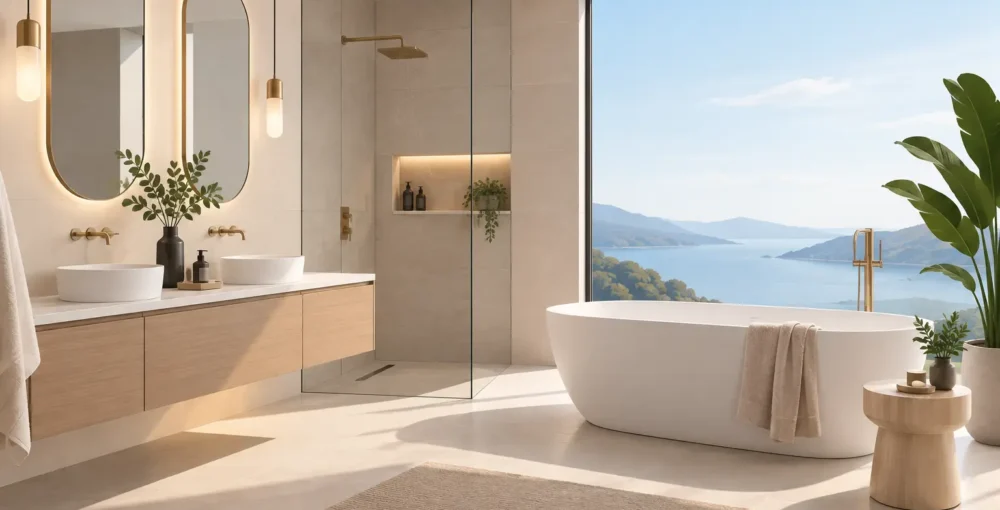
A remarkable bathroom is no longer judged by the number of fixtures it contains. It is judged by atmosphere: the weight of a stone basin, the quiet curve of a freestanding bath, the way concealed light catches a hand-finished surface at dusk. The most compelling luxury bathroom design trends are moving away from decorative excess and toward rooms with a clearer point of view – private sanctuaries shaped by material, proportion, and ritual.
For collectors, homeowners, and designers, this shift matters. A bathroom is one of the few rooms experienced almost entirely in private. It offers unusual freedom to be personal, sensorial, and uncompromising. The strongest projects treat it not as a utility room with expensive fittings, but as an intimate architectural composition.
Luxury Bathroom Design Trends: A More Sculptural Direction
The luxury bathroom is becoming softer in outline and stronger in identity. Rectilinear cabinetry and predictable hotel-style arrangements are giving way to monolithic volumes, rounded edges, and pieces with the presence of sculpture. This does not mean every element must be dramatic. It means each element should appear deliberately chosen, as though it could stand alone.
A freestanding bathtub remains central to this language, but the preferred form has changed. Rather than ornate revivalism or generic minimalism, the emphasis is on generous, organic silhouettes: oval vessels, asymmetric profiles, and carved forms that appear gently shaped by water. The best examples feel substantial without becoming heavy-handed.
The same sensibility is reaching vanities and washbasins. A basin may be integrated into a single block of stone, formed as a shallow sculptural depression, or set upon a textured console with a softened profile. These gestures create visual calm because the room contains fewer competing lines.
Curves Need Discipline
Organic form is not an excuse for visual softness everywhere. Curves are most powerful when balanced by architectural restraint: a precise wall plane, a strong slab floor, or a crisp reveal around a mirror. Without that counterpoint, a room can feel themed rather than composed.
Scale also determines success. In a London townhouse bathroom, for example, an expansive circular tub may consume too much of the room’s breathing space. A custom oval basin or curved plaster niche can deliver the same sculptural warmth more intelligently. Luxury is not measured by size alone. It is measured by the confidence of proportion.
Material Is Becoming the Main Decoration
The next generation of high-end bathrooms relies less on applied ornament and more on material character. Veined stone, hand-worked metal, mineral plaster, glazed ceramic, smoked glass, and richly grained timber bring depth that cannot be replicated by an accessory scheme.
Natural stone remains a defining choice, especially when selected for movement rather than uniformity. Calacatta and other pale marbles still have their place, but darker, earthier selections are increasingly prized: tobacco-toned travertine, green onyx, deeply veined quartzite, and stones with fossil traces or unexpected mineral shifts. Their imperfections are not defects to conceal. They are the reason each surface becomes singular.
There is, however, a practical consideration. Highly porous stones and delicate finishes demand knowledge, maintenance, and an honest discussion of how the room will be used. A dramatic natural stone basin in a guest powder room can remain pristine with modest care. In a family bathroom used every morning, a more resilient material or carefully sealed finish may be the wiser expression of luxury.
Hand-Finished Surfaces Create Intimacy
Perfectly polished surfaces reflect light beautifully, but they are no longer the only definition of refinement. Honed stone, brushed metal, satin lacquer, and hand-troweled plaster offer a more tactile form of richness. They absorb and diffuse light, making the room feel quieter and more enveloping.
This is where atelier-made elements distinguish themselves from standard specification. A hand-finished surface holds minute variations in tone and texture. It has evidence of the maker’s hand. In a room designed for stillness, that human irregularity can be more compelling than industrial perfection.
Wellness Is Moving Beyond the Spa Cliche
Wellness remains central, yet the language is becoming more discreet. The aim is not to recreate a commercial spa with an abundance of gadgets. It is to create rituals that belong naturally to the home: a deep soaking bath near a garden view, a steam room lined in warm stone, a shower with calibrated lighting and a place to sit.
The most successful wellness bathrooms are designed around transition. One moves from water to warmth, from bright morning light to low evening illumination, from a polished wet zone to a softer area for dressing and rest. When space allows, a chaise, sculptural stool, or small side table can make the room feel residential rather than clinical.
Technology should support this experience without announcing itself. Concealed controls, integrated speakers, programmable lighting, and precise temperature settings are valuable when they recede into the architecture. Visible screens and overly complex interfaces often date quickly. The more enduring approach is to make comfort feel instinctive.
Light Is Treated as a Material
In luxury bathrooms, lighting is no longer an afterthought installed above the mirror. It is part of the room’s material composition. A backlit stone wall can reveal veining like a landscape. A concealed line of light beneath a floating vanity can make its mass appear to hover. A carefully aimed pendant can turn a bath into a focal object after dark.
Layering is essential. Bright, accurate lighting is needed for grooming, while indirect illumination creates the slower mood appropriate for bathing. Candlelight remains powerful precisely because it is imperfect, but it should be an enhancement rather than the only source of atmosphere.
Mirrors are becoming more architectural as well. Oversized, shaped, tinted, or gently aged glass introduces depth without adding clutter. The ideal mirror does more than reflect a face. It extends the room’s perspective and amplifies the character of its materials.
Privacy Has Become a Design Luxury
For high-net-worth homeowners, privacy is increasingly expressed through planning as much as through finish. A dressing room that flows into the bath suite, a concealed water closet, discreet storage for personal objects, and carefully positioned windows all protect a sense of retreat.
This is especially relevant in urban residences, where neighboring sightlines, compact plans, and shared walls require more thoughtful design. Ribbed glass, deep reveals, planted courtyards, and filtered daylight can preserve openness without exposure. A bathroom should feel connected to its setting, but never observed.
Storage follows the same principle. The visual field is calmer when bottles, devices, towels, and daily necessities have a concealed place. That does not require sterile minimalism. It requires cabinetry that has been considered as part of the architecture, with interiors tailored to the owner’s routines.
The Case for Commissioned Pieces
As luxury interiors become less interested in recognizable catalog rooms, commissioned design is gaining a deeper role. A bespoke vanity, stone basin, screen, or lighting element gives a bathroom a visual signature that cannot be duplicated across residences. It also makes it possible to resolve difficult dimensions, unusual materials, and specific rituals with precision.
The distinction is not simply exclusivity for its own sake. Commissioning allows the designer and maker to control scale, junctions, color, finish, and tactile quality from the first sketch through fabrication. At Cedrimartini, this approach turns functional bathroom elements into collectible sculptural objects, made in Italy with a level of discretion suited to private commissions.
Still, not every element needs to be bespoke. A room often benefits from a measured mix: commissioned centerpieces paired with restrained, high-performing fittings. The key is hierarchy. Invest where the eye and hand will return most often – the bath, basin, vanity, stonework, lighting, and hardware – then allow supporting components to remain quiet.
Design for a Longer Life
The most valuable trend is resistance to trend-chasing. A bathroom becomes enduring when it is rooted in a client’s way of living, a home’s architecture, and materials that improve with age. This may mean accepting a patina on unlacquered brass, selecting a stone with variation, or choosing a form that feels slightly unexpected rather than instantly familiar.
A truly luxurious bathroom should not reveal everything at once. It should reward repeated use: the cool touch of carved stone in the morning, the softened glow of plaster in the evening, and the quiet certainty that no other room is quite the same.