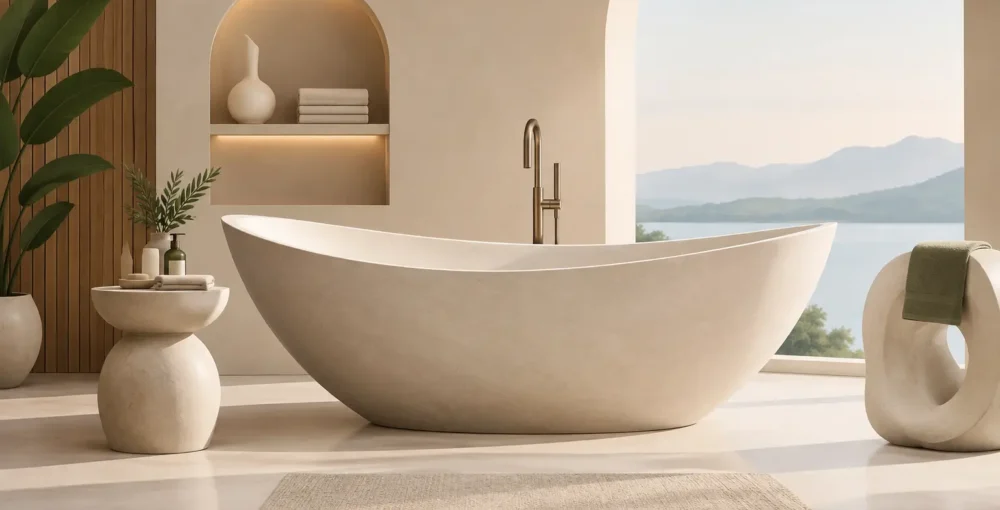
A freestanding bath can occupy the physical center of a room, yet its real power lies in what it makes the room feel like: quieter, more deliberate, entirely its own. The best sculptural bath pieces do more than accommodate a ritual of water and rest. They establish a private architecture of wellbeing, where material, light, and silhouette become inseparable.
For a residence, penthouse, yacht, or intimate hospitality suite, the right object should never feel selected from a catalog. It should feel inevitable within its setting: a hand-shaped presence with the authority of art and the intimacy of a personal retreat.
What Makes a Bath Piece Sculptural?
Sculptural bath design is not simply about an unusual outline. A dramatic form without proportion, tactility, or a considered relationship to the room soon becomes decorative noise. The most enduring pieces hold their visual force in silence. Their curves guide the eye; their surfaces invite touch; their mass gives the interior a sense of permanence.
This distinction matters especially in rooms where hard finishes can become cold or overly technical. A bath in a generous organic form softens stone, glass, and architectural concrete. A carved basin introduces a focal point at a human scale. Even a modestly sized object, such as a stool or pedestal, can give a bathing space a more composed and collected identity.
True sculptural presence is also inseparable from workmanship. Continuous curves, softened edges, exact junctions, and layered finishes reveal the hand and the discipline behind the object. These are qualities that cannot be reduced to a photograph or a specification sheet. They must be understood through depth, weight, texture, and the way light settles across a surface.
12 Best Sculptural Bath Pieces to Consider
The following categories offer a considered starting point for creating a bathing room that feels personal rather than prescribed. The best choice depends on the room’s scale, the desired level of visual drama, and whether the project calls for a single statement or a complete sculptural composition.
1. The Monolithic Freestanding Tub
A monolithic tub is the defining piece for a bath conceived as a sanctuary. Its body should read as a single, resolved volume, whether formed in mineral composite, hand-finished resin, stone, or an experimental aggregate. Low and elongated profiles create a grounded, meditative effect, while taller oval forms lend the room a more ceremonial character.
The trade-off is spatial. A sculptural tub requires generous clearance so its silhouette can be read from every side. In a compact room, crowding it with cabinetry diminishes precisely what makes it special.
2. The Carved Stone Basin
A basin carved from a substantial block of stone offers an ancient sense of permanence, even in a rigorously contemporary interior. Travertine, onyx, marble, and lesser-known natural stones each bring a different temperament, from quiet chalkiness to dramatic veining and translucence.
Stone asks for discernment. Highly expressive slabs can overwhelm a small room, while porous materials demand appropriate sealing and considered daily care. When selected well, the basin becomes both a functional vessel and a collectible focal point.
3. The Organic Double Vanity
For a principal suite, a double vanity can become an architectural gesture rather than a line of cabinetry. Consider a continuous, curved volume with integrated basins, softened corners, and a finish that feels almost geological. It creates visual calm because it eliminates unnecessary interruptions.
This is particularly compelling in rooms shared by two people. The design provides individual function without splitting the composition into separate, competing elements.
4. The Totemic Pedestal Sink
A pedestal basin condenses a great deal of personality into a small footprint. The most successful examples appear almost to rise from the floor, with a stem, plinth, or faceted body that gives the basin its own visual gravity.
It is ideal for powder rooms, guest suites, and dressing-room baths, where one exceptional object can carry the entire interior. Storage is limited, of course, so this choice works best when the room has concealed cabinetry elsewhere.
5. The Sculpted Shower Bench
A built-in bench is often treated as a purely practical element. It should not be. A softly contoured bench, shaped as an extension of the wall or floor plane, changes the experience of the shower from an enclosure into a place of pause.
Materials should be selected for both comfort and resilience. Honed stone, textured composite, and carefully treated teak all offer different sensory qualities. The form must also respect drainage, cleaning, and safe movement, because a beautiful object that complicates daily use is not a luxury.
6. The Ritual Stool
A low stool beside the bath brings a domestic intimacy to an otherwise formal room. It can hold towels, a book, bath salts, or nothing at all. In sculptural terms, it provides a counterpoint to the bath’s larger volume and makes the room feel inhabited.
Choose a piece with enough substance to stand independently as an object. Hand-carved wood, cast metal, stone, and molded resin each offer a distinct conversation with the surrounding finishes.
7. The Overscaled Mirror
A mirror does more than reflect a vanity. An irregular, oversized, or deeply framed mirror can alter the perceived scale of the entire room, catching daylight, candlelight, and the movement of water.
The strongest designs avoid literal ornament. Their sculptural quality comes from proportion, edge treatment, and the quiet tension between reflection and solid material. In rooms with richly veined stone, a simpler mirror form often provides the necessary restraint.
8. The Luminous Wall Sconce
Bath lighting deserves the same authorship as furniture. A sculptural wall sconce, particularly one in frosted glass, alabaster, ceramic, or patinated metal, introduces a softer layer of light than recessed fixtures alone can provide.
Place sconces to flatter faces at the vanity and to create depth after dark. Their scale matters: undersized fixtures disappear, while excessively decorative ones can disrupt the calm of the room.
9. The Hand-Finished Towel Ladder
A towel ladder can offer utility without the visual heaviness of conventional rails. In a warm metal, sculpted wood, or custom-finished composite, it becomes a vertical accent that introduces rhythm to a wall.
Its informality is part of its appeal, though it is best reserved for relaxed private environments. In a highly formal bath, an integrated heated rail may better support the architectural language.
10. The Cast Metal Faucet as Jewelry
Fittings are often selected late, then asked to disappear. In a sculptural bath, they deserve a more intentional role. A faucet with a refined spout, tactile lever, or hand-applied patina can function as jewelry against stone or plaster.
The finish should be chosen for the long view. Living metals develop character over time, while coated finishes preserve a more consistent appearance. Neither is inherently superior; the decision is about whether the room should age visibly or remain controlled.
11. The Freestanding Screen
A sculptural screen can define the bathing zone without enclosing it. Made in fluted glass, perforated metal, carved wood, or a translucent resin, it brings privacy, shadow, and spatial layering to an open-plan suite.
This is especially effective where a bath sits within a bedroom or dressing area. The screen must be proportioned as architecture, not treated as an afterthought, with close attention to sightlines and the play of light across its surface.
12. The Custom Display Pedestal
A pedestal may hold a vessel, a rare fragrance bottle, a floral branch, or a single sculptural object. It introduces the collector’s instinct into the bath, making space for beauty that has no purely functional obligation.
For clients who want a room that cannot be replicated, this final layer is often decisive. Cedrimartini approaches such elements as part of a unified composition, developed from material research through to the final handmade finish.
How to Compose Sculptural Bath Pieces
The temptation is to make every object expressive. Resist it. A memorable bath typically needs one primary gesture, one or two supporting forms, and a field of quieter surfaces that allows the composition to breathe. If the tub is monolithic and emphatic, the vanity might be understated. If the stone basin carries dramatic veining, hardware and lighting should refine rather than compete with it.
Material continuity is equally powerful. Repeating a finish from a faucet in a mirror edge, or echoing the bath’s soft curves in a stool, creates cohesion without making the room feel matched. The goal is not uniformity. It is a visual language that feels composed by one hand.
Commissioned work offers particular value when standard dimensions will not honor the architecture. An awkwardly placed window, a curved wall, an unusually scaled suite, or a desire for a rare material can become the starting point for a piece made specifically for that condition. The result is not simply custom sizing. It is authorship.
The finest bathing spaces make room for stillness. Select objects with enough character to remain compelling after the novelty has passed, then let light, water, and time complete the experience.