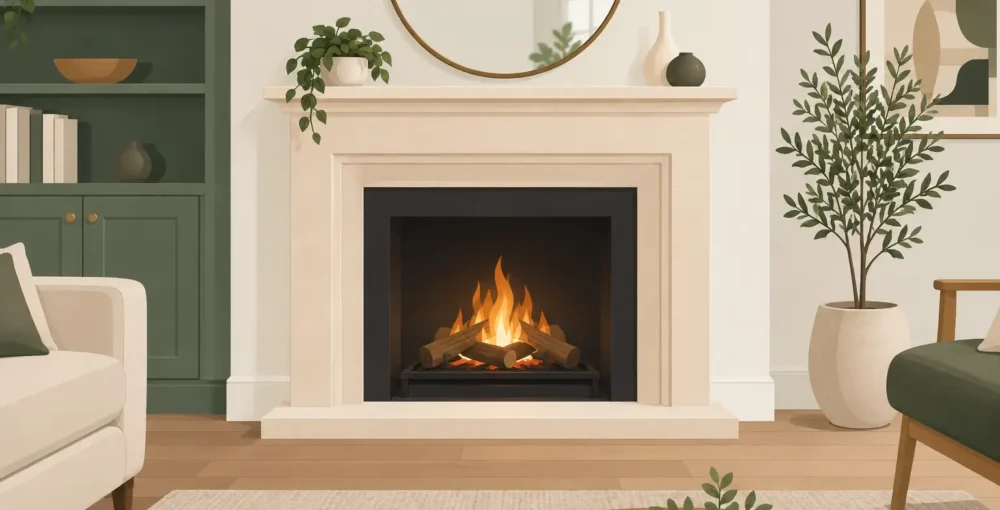
A fireplace is often assigned the most prominent wall in a room, yet too many are treated as a technical opening framed by a predictable mantel. A considered guide to bespoke fireplace surrounds begins elsewhere: with the understanding that the fireplace can be a sculptural object, defining atmosphere whether the fire is lit or not. Its material, silhouette, scale, and relationship to the architecture deserve the same attention as a commissioned table or a work of art.
For residences where every object is selected with intent, a bespoke surround offers something standard stonework cannot: authorship. It can soften a severe architectural volume, establish a quiet point of gravity in a minimal room, or introduce a tactile counterpoint to polished plaster, timber, and glass. The finest examples do not merely decorate a fire. They give the room its visual rhythm.
What Makes a Bespoke Fireplace Surround Different?
A bespoke fireplace surround is designed around a specific interior, its dimensions, its light, and the people who inhabit it. Rather than choosing from a catalog of fixed profiles, the owner and designer determine the proportions, material composition, surface treatment, and degree of visual presence from the outset.
That distinction matters most in rooms with strong architecture. A generic surround may be technically adequate but visually disconnected: too narrow for a tall ceiling, too ornate for a restrained interior, or too shallow to command a large wall. A custom piece allows every line to be adjusted. The fire opening can sit low and monolithic, be framed by an exaggerated arch, or become part of a continuous, hand-finished wall composition.
The process also invites material experimentation. Natural stone, patinated metal, ceramic, cast composite, textured plaster, and hand-worked timber each carry a different emotional register. In an atelier setting, these materials can be paired in unexpected ways, with the junctions, veining, edges, and hand marks considered as carefully as the overall form.
Begin With the Room, Not the Material
The temptation is to begin with a dramatic slab of marble or an admired reference image. A more enduring approach starts with the room itself. Consider the fireplace wall as a field of proportion. Its height and width, the ceiling line, nearby openings, built-ins, seating arrangement, and sightlines from adjoining spaces all influence what the surround should become.
In a formal living room with generous ceiling height, a fireplace may need verticality to hold its place. This does not necessarily call for ornament. A tall, softly rounded portal in travertine, for example, can create presence through mass and shadow alone. In a lower, more intimate room, an elongated horizontal composition may feel more natural, emphasizing a wide hearth and drawing the eye across the space.
The viewing distance is equally consequential. A deeply textured or visibly veined material becomes expressive when seen from across a room. Near a seating area, finer details emerge: a softened edge, an imperfect hand-applied finish, the subtle contrast between honed and polished surfaces. Bespoke work allows these experiences to be composed rather than left to chance.
Decide the Fireplace’s Role
A surround can be a quiet architectural anchor, a collectible centerpiece, or an element within a broader composition that includes shelving, seating, and art. None of these roles is inherently superior. The right choice depends on the character of the home and the confidence of its other elements.
When the room already contains exceptional artworks, patterned stone, or a dramatic view, restraint may be the greater luxury. A monolithic surround in a single material can lend weight without competition. Conversely, in a pared-back interior, the fireplace may carry the room’s identity. Here, a bold organic profile, a rare stone selection, or a sculptural ceramic surface can create the desired tension.
Choosing Materials for Presence and Longevity
Material is not simply a finish. It determines how the surround catches light, records age, and feels within the hand. It also needs to be selected with the fire system, heat output, and installation method in mind. A beautiful concept should always be developed alongside qualified fireplace, ventilation, and building professionals.
Natural stone remains compelling because no two blocks are identical. Calacatta and Arabescato marbles bring graphic movement; travertine offers warmth and porous depth; onyx introduces translucency when used with careful restraint. Limestone can feel ancient and serene, while darker marbles and granites lend a more ceremonial presence. The key is not rarity alone, but the way the stone’s character serves the form. A strongly veined slab may be breathtaking on a broad plane yet distract from a delicate, curved silhouette.
Metal introduces another language. Bronzed, blackened, or patinated surfaces shift with daylight and develop further complexity over time. They work particularly well when the intended effect is precise, architectural, and slightly elemental. Metal can be used as a fine inlay, a hearth plane, or a full surround, though it requires thoughtful detailing to account for expansion and heat.
Hand-finished plaster and mineral composites offer freedom for continuous, sculptural forms. They can create the impression that the fireplace has been shaped directly from the wall, with no obvious seam between architecture and object. Their apparent simplicity is deceptive. The quality of the substrate, curves, pigment, and final surface treatment determines whether the result feels quietly masterful or merely flat.
Form: Why Curves Change the Room
A rectangular mantel is familiar because it is easy to specify. But bespoke design makes room for forms that feel more responsive to the body and the space: softened corners, low arches, asymmetric shoulders, generous chamfers, and volumes that appear gently eroded rather than mechanically cut.
Curved fireplace surrounds have a particular ability to temper contemporary interiors. They introduce shadow and movement into rooms defined by straight architectural lines, without requiring decorative excess. A rounded opening can also make a substantial material feel less severe. This is especially effective with dense stones, dark metals, and heavily textured finishes.
There is a trade-off. Expressive forms demand discipline in proportion. A curve that is too shallow can look accidental; one that is too theatrical can overwhelm a modest room. The most successful designs use geometry with restraint, allowing the material and scale to do much of the work.
The Importance of Hearth, Mantel, and Negative Space
The surround is rarely experienced in isolation. The hearth establishes a horizontal plane, offering visual grounding and, in some cases, a practical perch. A raised hearth feels architectural and ceremonial, while a flush hearth maintains a quieter, more contemporary line. Its depth should be determined by both the room’s circulation and applicable safety requirements.
The mantel can be present, recessed, or deliberately absent. A projecting mantel offers a place for objects and creates a traditional sense of framing. A mantel-less composition, by contrast, can feel more sculptural and elemental, especially when the surround is conceived as one continuous mass. The decision should reflect how the room will be used, not simply a preferred style.
Negative space matters just as much. The proportions of the firebox opening, the margin around it, and the empty wall above all affect the composition. Designers often focus on adding material, when the more sophisticated gesture is to leave a measured expanse undisturbed.
A Guide to Bespoke Fireplace Surrounds: The Commission Process
A successful commission begins with precise information: architectural drawings, photographs, dimensions, the fireplace specification, and an understanding of the intended finishes nearby. For renovation projects, a site survey is essential. Existing walls are rarely as regular as drawings suggest, and a handcrafted surround depends on accurate conditions.
The design phase should establish the silhouette and material language before fabrication begins. Physical samples are valuable here, particularly for stone, plaster, patina, and ceramic. A digital rendering can demonstrate scale, but it cannot replicate the depth of a vein, the softness of a honed edge, or the way a hand-applied surface receives evening light.
Fabrication should remain closely controlled from concept through finishing. Cedrimartini approaches this work as an Italian atelier, where material research and handcraft are held within one creative process. That continuity protects the original design intent while allowing small, meaningful adjustments as the piece takes form.
Installation is the final act of the commission, not an afterthought. The surrounding construction, firebox tolerances, substrate, weight of the material, and access route all require early coordination. Large stone elements may need to be fabricated in sections, while a seemingly simple plaster form may depend on a highly prepared structural base. These realities do not diminish the poetry of the object. They are what allow it to endure.
Let the Surround Belong to the House
The most memorable fireplace surrounds do not announce themselves through scale or expense alone. They feel inevitable, as though the room had been waiting for that exact curve, surface, and weight. Choose the form that gives the architecture a center, choose materials that become richer with time, and allow enough patience for the hand of the maker to remain visible.