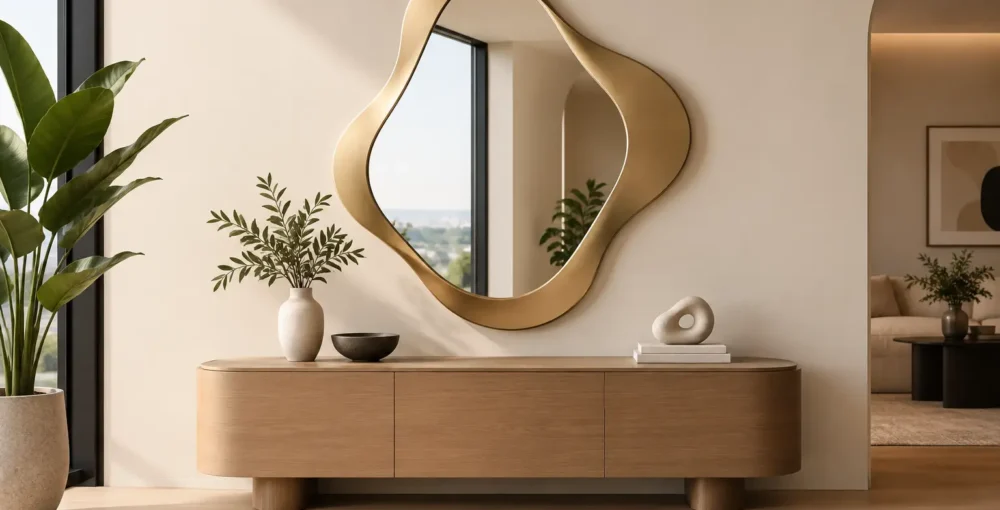
A mirror is often treated as a practical object, placed where light is scarce or a final glance is required. A bespoke sculptural mirror asks for a more considered role. It can hold a room together, alter its perceived scale, and introduce a composition of line, shadow, reflection, and material that feels inseparable from the architecture.
For a private residence, a hospitality suite, or a carefully composed entrance, the distinction matters. A conventional mirror fills a function. A sculptural mirror establishes a presence. Its reflective surface may be essential, yet the object around it is what gives the space its character: a hand-shaped frame, an unexpected silhouette, a finish with depth, or a deliberately imperfect curve that changes as the day moves across it.
Why a Bespoke Sculptural Mirror Changes a Room
Mirrors possess an unusual authority in interiors because they work with what is already there. They borrow a view, multiply the warmth of a wall finish, draw daylight deeper into a room, and create a second reading of nearby art or furniture. When the mirror itself is sculptural, these effects become intentional rather than incidental.
The greatest value is not simply visual enlargement. It is the ability to compose an atmosphere. A tall, vertically weighted form can give a low-ceilinged dressing room greater poise. A broad, low mirror above a fireplace or console can establish a calm horizontal rhythm. An asymmetric piece placed at the end of a corridor can turn a transitional space into a destination.
This is why proportion should come before ornament. A piece may be dramatic in profile, but it must still belong to the room. Its outer dimensions, reflective area, thickness, edge treatment, and distance from adjacent objects all influence whether it feels inevitable or merely imposing.
Reflection as a Designed Material
Reflection is not neutral. Clear mirror glass offers precision and brightness, while smoked, bronze-toned, antiqued, or softly distressed surfaces create a more restrained and atmospheric result. Each shifts the emotional temperature of an interior.
A darker reflective plane can bring depth to pale stone, plaster, or travertine without making the room feel cold. Antique treatments may suit an interior with layered history, where a flawless reflection would feel too abrupt. In a contemporary setting, a pristine mirror set within a tactile, hand-worked surround creates a compelling contrast between clarity and irregularity.
The selection depends on what the mirror is meant to return to the viewer. A view of garden foliage, water, or changing sky benefits from a surface that retains luminosity. In a room rich with artwork and collected objects, a more muted mirror may prevent visual excess. Luxury lies in deciding what deserves amplification and what is better softened.
The Value of Commissioning Beyond Standard Dimensions
Standard mirrors are made to fit common walls. Bespoke work begins with the particular conditions of one room: the sightlines on arrival, the grain and color of the surrounding materials, the height of the ceiling, and the way natural and artificial light move over the space.
That process allows a designer or client to determine whether the piece should sit flush to the wall, project outward like low relief, or appear almost detached from it. It also permits exact control of scale. A mirror designed for a double-height entry should not be a domestic shape enlarged without thought. It needs visual mass, an edge profile that can be read from a distance, and a composition capable of holding its own against generous architecture.
Conversely, a smaller commission can be no less significant. In a powder room, beside a bed, or within a private dressing area, a hand-formed mirror can introduce intimacy. Its value comes from proximity. The owner encounters the details daily: a burnished contour, the texture of cast metal, the softness of a lacquered curve, the subtle tension between frame and glass.
At Cedrimartini, this degree of authorship is protected through internal design and fabrication. The object is not passed between anonymous suppliers. Form, finish, and execution remain within the atelier’s control, allowing a commission to preserve its original intention from first drawing to final installation.
Materials That Give the Object Its Character
A sculptural mirror is rarely defined by glass alone. Its frame or surrounding body determines its visual weight and its relationship to the room. Material choice should be approached as a sensory decision as much as an aesthetic one.
Metal can be architectural, polished to a liquid brightness or given a darker patina that reads almost geological. Wood offers grain, warmth, and a quieter connection to cabinetry, flooring, or paneling. Stone introduces permanence and a sense of excavation, especially when its edges are carved or softened rather than cut into strict geometry.
Resin, lacquer, plaster-like composites, and experimental finishes offer another language. They allow for generous organic volumes, continuous curves, and surfaces that appear molded by hand rather than assembled from standard parts. Such materials can be especially effective in interiors seeking a collectible-design perspective: not a decorative frame around a mirror, but an object with its own sculptural logic.
There are trade-offs. A highly polished material magnifies light but also reveals fingerprints and requires attentive care. Deeply textured surfaces offer extraordinary shadow and tactility, though they may be less suited to narrow passages where clothing or bags can catch on pronounced forms. Natural stone brings irreplaceable variation but requires careful structural planning due to weight. Bespoke design is valuable precisely because these decisions can be made openly, rather than accepted as limitations after purchase.
Where a Sculptural Mirror Belongs
The most successful placement is rarely the most obvious. Above a console in an entry remains a classic choice because it creates a moment of arrival, but other locations can be more revealing.
In a living room, a mirror positioned to catch an artwork, a fireplace flame, or the changing light of a window can enrich the room without competing with its principal focal point. In a dining room, it can extend the glow of candlelight and create a more ceremonial evening setting. In a bedroom, an asymmetrical full-length form can soften the room’s architecture and make the daily ritual of dressing feel more private and composed.
Bathrooms present a particularly rich opportunity. Here, the mirror is used closely and frequently, yet it need not feel clinical. A custom silhouette above a stone vanity can counterbalance the linear discipline of taps, joinery, and tile. Humidity, cleaning routines, and lighting must be considered from the outset, particularly when the design includes delicate finishes or integrated illumination.
For exterior or semi-covered settings, the conversation changes. Materials must withstand temperature shifts, moisture, and ultraviolet exposure. The aesthetic can remain refined, but the construction needs to be honest about the environment. A piece intended for a covered terrace should be designed as an outdoor object, not a delicate interior work moved outside for effect.
How to Give the Commission a Clear Direction
A commission benefits from ambition, but also from a precise brief. The most useful starting point is not a catalog image. It is an understanding of the room: plans, photographs, key dimensions, existing material samples, and the intended feeling of the space.
Consider whether the mirror should recede, converse with a dominant architectural feature, or become the room’s defining gesture. Identify what it will reflect at different times of day. A mirror opposite a beautiful window behaves very differently from one facing a storage wall or an active circulation route.
It is also worth deciding where visual irregularity is welcome. Organic forms can be fluid and expressive, yet every curve has a degree of movement. Some interiors call for a gentle asymmetry that rewards closer inspection. Others can carry a more assertive silhouette, where the mirror reads almost as wall sculpture. Neither is inherently superior. The right choice depends on the stillness or energy already present in the architecture.
A Lasting Object, Not a Passing Accent
The enduring appeal of a bespoke sculptural mirror lies in its dual nature. It is useful, but it is also capable of becoming part of a collection. It holds light, frames a point of view, and records the character of the rooms around it without surrendering its own identity.
Before commissioning, stand in the intended location at several hours of the day and observe what the wall already receives: light, shadow, views, movement, and silence. The strongest mirror will not merely occupy that space. It will give those conditions a form worth returning to.