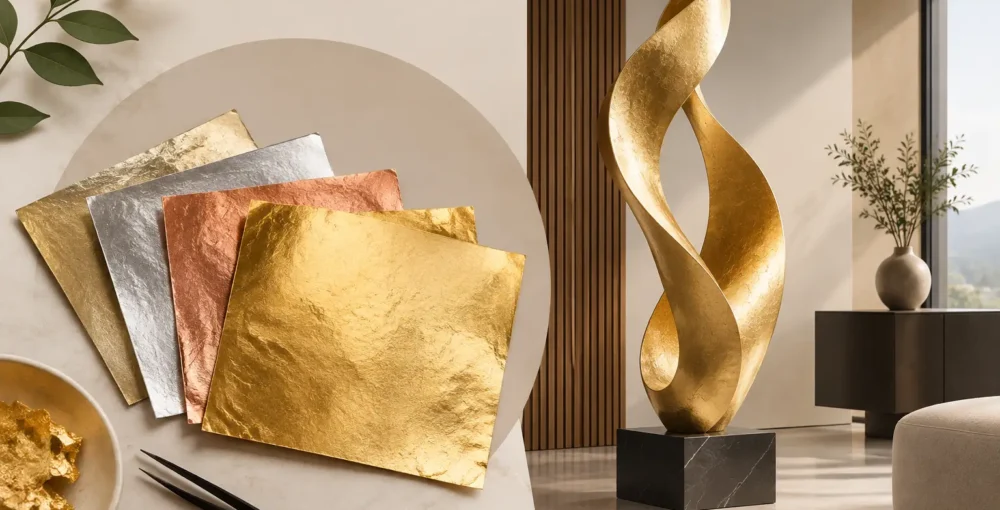
A gilded surface is never merely gold. It is a field of reflected light, a changeable skin that can make a curved cabinet feel weightless at noon and deeply ceremonial after dusk. Knowing how to select metal leaf begins with this understanding: the right choice is not determined by color alone, but by the relationship between material, form, light, and the life a piece will lead.
For a private residence, a hospitality interior, or a collectible object, metal leaf should be chosen as an integral part of the design language. A bright yellow gold leaf may animate a restrained architectural setting. A muted palladium surface may give an organic form a cool, lunar reserve. The decision requires an eye for atmosphere as much as an appreciation of material quality.
How to Select Metal Leaf Beyond Its Initial Shine
Metal leaf has an immediate visual force, but its lasting value lies in nuance. Its luster can be brilliant, softened, antiqued, irregular, or nearly spectral. Before selecting a finish, consider what the surface must communicate. Is the object intended to command a room, to reward close viewing, or to quietly connect stone, timber, and textiles within a composed interior?
The scale of the piece matters. A small sculptural object can carry a luminous, high-reflective leaf without overwhelming its surroundings. On a monumental wall panel, kitchen element, or sweeping furniture volume, the same finish may become too insistent unless its brilliance is moderated by texture, patina, or a carefully considered lighting scheme.
It also depends on the geometry. Metal leaf reveals every transition in a form. On a crisp, rectilinear plane, it emphasizes precision and architectural rhythm. Across a hand-shaped curve, it catches light in gradual shifts, making the gesture of the maker visible. This is why leaf is especially compelling on sculptural furniture: it turns volume into an experience that changes as one moves through the room.
Begin With the Metal, Not the Name
“Gold leaf” is often used as a general description, yet the category contains distinct materials with very different visual and technical qualities. Selecting by name alone can lead to a surface that looks convincing in isolation but feels misplaced once installed.
Gold leaf
Genuine gold leaf is available in a range of karats. Higher-karat leaf carries a richer, warmer, and more stable yellow, with a character that resists tarnishing. It is particularly appropriate for heirloom objects, high-touch ceremonial spaces, and pieces expected to retain their original tone with minimal change over decades.
Lower-karat golds introduce other metals into the alloy. They can appear paler, greener, rosier, or more antique, depending on their composition. Their tonal complexity may be precisely what an interior needs, especially beside warm plaster, smoked oak, bronze, or richly veined stone. Yet they may require more protection than high-karat gold, particularly in humid or exposed settings.
Silver leaf and palladium leaf
Silver leaf has a sharp, lucid brightness that can lend a room a refined, almost liquid quality. Its limitation is oxidation. Left unprotected, silver darkens over time, which may be welcome in a deliberately evolving finish but undesirable in a pristine contemporary composition.
Palladium offers a cooler, quieter alternative. It has the silvery clarity of precious metal without silver’s tendency to tarnish. It suits interiors where gold would feel too familiar or too warm: pale limestone, charcoal lacquer, ivory bouclé, and restrained monochrome palettes. Palladium can be extraordinarily sophisticated, though it asks for precise lighting to reveal its full depth.
Copper, brass, and composition leaf
Copper leaf introduces warmth that is more mineral and expressive than gold. It can move from fresh rose-orange to deep burnished umber as it ages, depending on the protective system and environment. Brass leaf, sometimes called Dutch metal, brings an accessible golden effect with a more lively, slightly green-yellow cast than genuine gold.
Composition leaf is often useful when a large surface calls for visual drama without the cost of precious metal across every plane. Its trade-off is longevity. Unlike genuine gold, brass and copper-based leaves can oxidize, so they demand an appropriate sealant and careful consideration of maintenance. For a limited-edition piece designed to acquire character, that evolution can be part of its appeal. For a bathroom feature or coastal project, it may be a reason to choose differently.
Read the Room’s Light Before Choosing a Tone
A leaf sample under atelier lighting is only the beginning. Metal surfaces are profoundly responsive to their context, and an elegant selection must be tested where it will live.
North-facing rooms tend to receive cool, diffuse light. A warm gold or copper leaf can bring balance and presence to these spaces, while palladium may heighten their atmospheric restraint. South- and west-facing rooms carry stronger sun and more pronounced reflections. In such settings, a softly burnished leaf, a patinated finish, or a leaf beneath a toned glaze may feel more composed than a mirror-bright surface.
Artificial light changes the equation again. Warm lamps enrich gold but can make brass appear overly yellow. Cool LED lighting can flatter palladium and silver, yet leave copper looking flat unless its warmth is deliberately supported. The most persuasive projects assess samples in morning light, evening light, and the actual light temperature planned for the interior.
Do not overlook what the leaf will reflect. A gilded console opposite a garden may borrow green and gray from the landscape. A palladium screen near dark marble may take on a dramatic graphite cast. Metal leaf is never seen alone. It gathers the room into itself.
Decide Whether Perfection or Evidence of the Hand Is Desired
Leaf is applied in sheets, and the joins can be concealed, celebrated, or transformed through technique. This choice defines the emotional register of the finished surface.
A smooth, even application creates a continuous field of light. It is suited to disciplined, architectural interiors and pieces whose form should remain visually pure. A lightly distressed application reveals seams, fine fractures, and variations in density. It brings depth to larger planes and gives the object an immediate sense of history.
There is no universal hierarchy between the two. A flawless gilded volume can feel almost otherworldly. A surface that preserves the irregularity of hand application can feel more intimate and alive. What matters is consistency between finish and intention. A visibly artisanal leaf treatment belongs on a form that welcomes tactility; it can feel arbitrary when applied to an object defined by severe mechanical precision.
At Cedrimartini, material experimentation is treated as an alchemical process rather than a decorative afterthought. The application method, the base color, the adhesive, the protective layers, and the final hand-finishing all influence the final surface. A leaf is only one part of the composition.
Match the Finish to Use and Environment
A leafed surface on a gallery plinth has different requirements from one on a dining table, bathroom vanity, or exterior object. Beauty must be protected by judgment.
High-touch surfaces need a carefully engineered topcoat that protects against abrasion, moisture, and household cleaning while preserving the leaf’s optical depth. Too heavy a coating can make the surface look plastic or mute the subtle transitions between sheets. Too little protection can leave a vulnerable alloy exposed to fingerprints, water marks, and oxidation.
Bathrooms, spas, and coastal locations are especially demanding. Humidity and salt can accelerate change in silver, copper, brass, and lower-karat golds. In these environments, high-karat gold or palladium is often the more dependable choice, supported by a finish system suited to the substrate and intended use.
For exterior applications, the question becomes even more specific. Direct sun, rain, pollution, and thermal movement require materials and processes designed for exposure. A metal leaf effect may be possible, but not every leaf belongs outdoors. The honest choice is the one that respects the environment rather than forcing an interior finish into a harsher setting.
Request Samples That Tell the Truth
A small swatch can be seductive, but it cannot answer every question. Request samples on the actual substrate whenever possible. Leaf over lacquered timber, plaster, resin, metal, and composite surfaces will each hold light differently. A darker ground may deepen the joints and lend the surface gravitas; a warm ground can intensify gold; a cool ground can make silver and palladium feel cleaner.
Ask to see samples with the proposed protective finish, not leaf alone. Compare polished, satin, brushed, and distressed options beside the other materials in the scheme. Then view them vertically and horizontally. A finish that appears discreet on a sample board may become dramatically reflective across a tabletop or cabinet front.
The most successful selection is often the one that reveals more with time. Choose metal leaf not simply for the instant it catches the eye, but for the shifting conversation it creates between hand, architecture, and light. A properly chosen surface gives a room a memory before it has even been lived in.