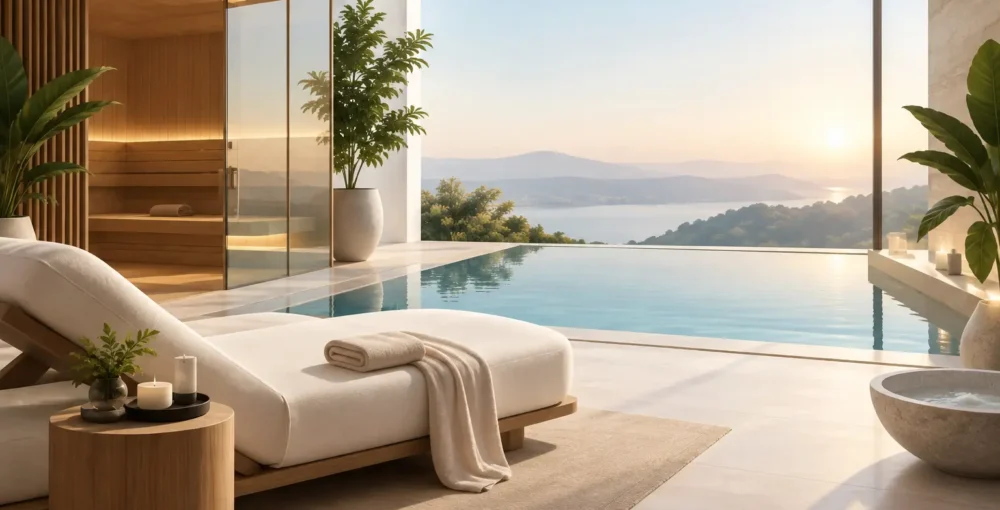
A monolithic stone basin, warmed to the touch before dawn. A curved chaise positioned for the late-afternoon light. Steam that arrives silently, without a visible grille or control panel interrupting the architecture. The future of luxury wellness interiors will not be defined by how many treatments a residence can contain. It will be defined by the quality of the private rituals those spaces make possible.
For discerning homeowners, wellness is moving beyond the gym annex and the decorative spa bathroom. It is becoming a considered dimension of domestic life: one that shapes sleep, recovery, bathing, solitude, and the return from a highly visible world to a protected inner one. The most distinguished interiors will make this feel instinctive rather than engineered.
Wellness Becomes a Private Architecture of Ritual
The luxury wellness room of the past often announced itself through equipment. There might have been a sauna, a whirlpool, a treatment table, and a display of technology. The emerging approach is quieter and more architectural. It begins with a question that is more personal than programmatic: how does the client wish to feel at different moments of the day?
A bathing suite may be composed around a slow sequence of heat, water, rest, and cooling air. A bedroom may include a recessed alcove for breathing practices or massage, separated from the sleeping area by a hand-finished screen. A lower-level spa may feel less like a commercial facility and more like a private grotto, where curved walls, low light, and a carefully controlled acoustic atmosphere suspend ordinary time.
This shift matters because true luxury is no longer measured solely by abundance. It is measured by the rare ability to remove friction. The most compelling spaces will anticipate a ritual without prescribing it too rigidly. A room for restoration should be able to host a quiet bath after travel, a moment of recovery after training, or a long evening of stillness without feeling like a specialized machine.
The Future of Luxury Wellness Interiors Is Sensory
Visual beauty remains essential, but wellness is experienced with the entire body. The feel of a surface under bare feet, the mineral scent released by warm stone, the weight of a solid bronze handle, and the absence of echo all influence whether a room offers genuine respite.
This will elevate materials from finish selections to active participants in the experience. Honed natural stone, hand-worked plaster, oxidized metals, richly grained woods, and experimental composite surfaces each carry a distinct temperature, texture, and visual depth. Their value lies not in a trend-led palette, but in their capacity to age with dignity and create a sense of permanence.
Organic forms will continue to gain ground because they soften the visual discipline of a residence. A sculptural bathtub with a generous, continuous profile invites the body to settle. Rounded seating changes circulation through a room. A custom washbasin can become the central object of a bathing space, its silhouette holding shadow and reflected light as carefully as it holds water.
There is a trade-off. Highly tactile materials require knowledge, care, and correct detailing. Certain stones need sensitive sealing. Patinated metal will evolve rather than remain untouched. Wood near water demands exceptional construction. For clients who value character, this is not a compromise. It is the difference between a living material and a sterile imitation.
The Return of the Bathing Suite
The bathroom is increasingly becoming a bathing suite: an intimate environment designed for unhurried use. Its finest expression is not necessarily expansive. A compact urban residence can achieve profound luxury through proportion, concealment, and material continuity.
The bath itself may stand as a collectible object rather than a conventional fixture. Storage disappears into architectural volumes. Mirrors are treated as instruments of atmosphere, with softened reflections and controlled illumination. Even the threshold matters: entering the room should feel like passing from the operational pace of the home into another register.
For larger residences, separate zones for bathing, steam, dressing, and repose create a more ceremonial experience. Yet compartmentalization should never become clinical. The spaces must remain connected by a common language of texture, light, and form.
Technology Should Serve Discretion
The most advanced wellness interiors will contain sophisticated systems, but they will not look technological. Climate control, circadian lighting, water filtration, sound management, chromotherapy, and personalized heat settings can improve daily life. Their presence should be nearly imperceptible.
This is especially important in homes where the interior is collected as art. A bank of bright controls can diminish the authority of a beautifully resolved stone wall. Visible speakers may disrupt the calm of a steam room. The design challenge is to integrate performance into the architecture while retaining intuitive operation.
There is also a limit to personalization. Technology that constantly requests attention can introduce the very agitation wellness rooms are intended to relieve. The best systems offer choice, then recede. A client should be able to set a preferred bathing temperature or evening light scene, but should never need to manage a dashboard to enjoy a private sanctuary.
Wellness Extends Beyond the Spa Room
The future is not confined to one designated area. It will be present in the way an entire residence handles light, air, sound, and transitions between social and private life.
Bedrooms will favor calmer visual fields, layered light, and pieces chosen for physical comfort as much as visual distinction. Dressing rooms may incorporate seating intended for pause rather than mere utility. Entrances can use shadow, sculptural consoles, and natural materials to create a decompression point before the home opens fully.
Outdoor wellness will also become more considered. Rather than placing standard furniture around a pool, private terraces and garden rooms will be composed as immersive settings for rest. A hand-finished daybed beneath a pergola, a carved stone shower concealed among planting, or a seating composition that follows the topography of the site can make the landscape part of the ritual.
For hospitality and high-end development, this philosophy has particular value. Residents and guests are increasingly sensitive to whether a space feels genuinely restorative or merely expensive. A meaningful sense of well-being cannot be added at the end through accessories. It must be embedded in the spatial concept from the first sketch.
Collectible Craftsmanship Will Matter More
As wellness interiors become more personal, standardized luxury will lose its appeal. Clients who have access to everything do not need another room that could belong to anyone. They seek objects with provenance, precise scale, and material narratives that cannot be replicated through mass production.
This is where the atelier model becomes decisive. When design and fabrication remain under one roof, the proportion of a basin, the radius of a seat, the density of a surface, and the junction between two materials can be developed as a single artistic proposition. The result is not simply custom-made furniture. It is an environment with authorship.
Cedrimartini approaches this territory through limited-edition and one-of-a-kind pieces made by hand in Italy, where sculptural form and material experimentation are treated as inseparable. Such work is particularly compelling in wellness settings because the object is encountered closely and repeatedly. A piece designed for touch must reward touch over time.
Bespoke production also protects privacy. For clients creating deeply personal residences, discretion is not an added service. It is part of the luxury itself. The ability to commission off-market pieces without turning a private vision into a public reference carries real value.
Designing for Longevity Rather Than Fashion
Wellness has been affected by fast-moving aesthetics: pale wood, statement tile, monochrome stone, then the next visual formula. The interiors with lasting power resist this cycle. They favor proportion over novelty and material conviction over decorative noise.
That does not mean every room must be subdued. A saturated onyx surface, a hand-cast metal wall, or a vivid sculptural object can bring dramatic presence. The distinction lies in intention. One exceptional gesture, placed within a calm architectural composition, often has more force than a room crowded with fashionable signals.
Longevity is also practical. High-use wellness environments need materials that can be maintained, systems that can be serviced, and layouts that support changing needs. A private steam room may be valuable for one household and unnecessary for another. A flexible treatment room, designed with concealed provisions for future equipment, can be the wiser choice. Bespoke luxury is most successful when it reflects how a client actually lives, not how they imagine luxury is supposed to look.
The most worthwhile commission begins with a precise conversation: which moments of the day deserve more calm, what materials feel instinctively right, and what should remain seen only by those who live there? Answer those questions first, and the future wellness interior becomes not a trend to purchase, but a private world made enduringly your own.