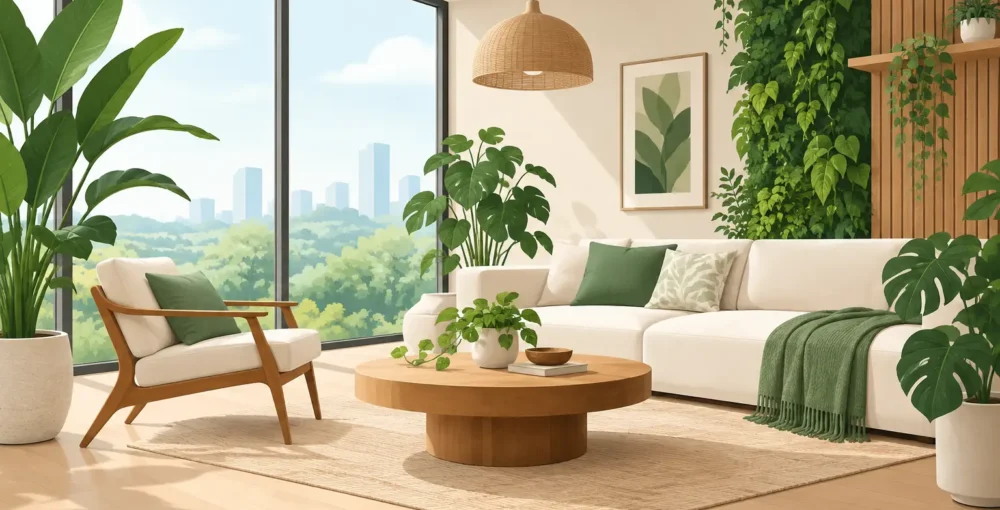
A mature olive tree in a polished stone planter can make an entrance memorable. Yet the most compelling biophilic interior trends are no longer defined by plants alone. They are expressed through the sensation of being held by a space: the softness of a hand-shaped curve, the gravity of mineral surfaces, shifting daylight across a textured wall, and materials that retain the evidence of their origin.
For private residences, hospitality suites, and collector-led interiors, biophilia has become less a decorative gesture than a discipline of atmosphere. The question is not how much greenery a room can contain. It is how architecture, objects, light, and natural matter can create a more instinctive relationship with the interior.
Biophilic Interior Trends Beyond the Indoor Garden
The early visual language of biophilic design favored living walls, oversized planters, and abundant foliage. Those elements still have a place, particularly in urban homes where a planted view offers genuine relief from the city. But greenery used without proportion or care can quickly feel performative. A room filled with plants but dominated by synthetic finishes, harsh lighting, and rigid geometry does not become restorative simply because it is green.
The more enduring direction is subtler. Designers are composing interiors around natural rhythms and sensory contrasts: cool stone against warm timber, a deeply veined surface beneath quiet plaster, seating that follows the body rather than forcing it into a hard angle. Nature is referenced not as a theme, but as a source of spatial intelligence.
This distinction matters in luxury interiors. A rare environment should not resemble a catalog of trend signals. It should feel inevitable, as though every material and silhouette belongs to the architecture, the light, and the life of its owner.
Organic forms are becoming architectural
Curved furniture has moved far beyond the occasional rounded sofa. Low tables with softened edges, monolithic seating, sculptural consoles, and freestanding bath forms are introducing a more fluid visual order. Their value is not merely aesthetic. Curves alter how one moves through a room, inviting circulation rather than creating a sequence of hard stops.
The most successful pieces do not imitate nature too literally. A chair need not resemble a leaf, nor should a table be reduced to a biomorphic novelty. Instead, the form may carry a sense of erosion, growth, or compression. It can appear shaped by pressure and time, even when made with exceptional technical precision.
For a residence with strong contemporary architecture, this approach is particularly effective. Sculptural furniture can temper severe planes and expansive glazing without competing with the building. In more historic settings, it can offer a measured counterpoint to decorative detail, introducing calm rather than contrast for its own sake.
Material Honesty Is the New Luxury
Biophilic interiors are increasingly defined by a return to materials that age, deepen, and reveal variation. Travertine, onyx, marble, clay, patinated metals, natural fibers, and richly grained woods possess qualities that manufactured uniformity cannot replicate. Their irregularity is not a defect to be corrected. It is often the very reason the material feels alive.
This creates a meaningful shift in what clients seek from bespoke work. The desired object is no longer simply flawless in the conventional sense. It is resolved with mastery while allowing the singular character of stone, timber, metal, or hand-applied finish to remain visible. A mineral inclusion, a change in veining, or the quiet movement of a patina becomes part of the object’s identity.
At Cedrimartini, material experimentation belongs to the creative process rather than arriving as a final surface choice. This is essential when producing collectible pieces. The relationship between form and material must be considered from the beginning, because a luminous stone may demand a different silhouette than a dark, tactile metal, and a hand-finished surface may transform how light settles across an object.
The importance of tactile contrast
A refined biophilic room is rarely built from one material family alone. It depends on deliberate contrast. A polished stone floor can be made more intimate by a handwoven wool rug. A carved timber cabinet gains presence against limewashed walls. Matte ceramic, brushed bronze, and leather can introduce different temperatures and degrees of reflection within the same composition.
The aim is not visual abundance. Too many expressive materials can make even a generous room feel restless. Instead, select a restrained palette with enough variation to invite touch and close observation. In a London townhouse, for example, pale limestone, smoked oak, plaster, and aged brass can hold a quiet dialogue with soft northern light. In a sun-filled coastal residence, honed stone, linen, pale wood, and darker mineral accents may feel more appropriate.
Light Must Be Treated as a Living Material
Daylight has always been central to biophilic design, but current projects are treating it with greater choreography. Rather than leaving large windows visually unmediated, designers are considering how sunlight travels, where it rests, and which materials will receive it throughout the day.
A ribbed glass partition can diffuse a bright exposure while preserving its movement. A satin metal surface can catch the last light of afternoon. A curved wall may create gradual shadow that makes a space feel deeper and more protective. These are not secondary effects. They determine the emotional register of a room.
Artificial lighting should extend this sensibility after dark. Uniform ceiling illumination tends to flatten material and erase atmosphere. Layered pools of light, concealed washes, sculptural lamps, and low-level illumination allow an interior to shift with the evening. The result is more intimate, but also more legible: stone reads as stone, texture becomes visible, and a carefully made object can hold its own presence.
There is a practical trade-off. Highly textured finishes and dramatic lighting require thoughtful maintenance, especially in homes used frequently by family, guests, or staff. A successful scheme balances sensuality with ease of living. Certain surfaces may be best reserved for a private dressing area, a powder room, or a formal salon, while high-traffic zones call for equally beautiful materials with greater resilience.
Water, Air, and the Ritual of Retreat
Bath and wellness spaces are becoming one of the most expressive settings for biophilic thinking. Here, the association with natural landscapes can be direct without becoming literal: stone basins, enveloping plaster, filtered light, warm metals, and the sound of water can produce the atmosphere of a private sanctuary.
The strongest interiors avoid the generic language of the spa. Instead of importing a resort aesthetic into a home, they create a personal ritual through scale and material. A deeply sculpted freestanding tub, for instance, can function as an architectural object. A custom vanity in veined stone may give the room a sense of permanence. Even a small bathroom can feel expansive when its surfaces are continuous, its lighting is restrained, and its objects have sculptural authority.
Air quality and scent also deserve consideration, though they are often overlooked in visual discussions of biophilia. Natural ventilation, carefully specified finishes, and discreetly integrated fragrance can affect how a space is experienced long after its first impression. These details are especially relevant in city apartments, where the interior must offer a counterbalance to dense surroundings.
Rarity Matters More Than Decoration
As biophilic aesthetics become more visible, there is a risk of repetition. The same bouclé forms, pale oak finishes, and generic ceramic vessels can make distinct homes feel interchangeable. For collectors and design-led clients, the response is not to reject the movement, but to demand greater authorship from it.
A one-of-a-kind table cut from an exceptional stone block, a hand-finished screen that filters light like a geological formation, or a seating piece developed for a particular room can carry biophilic ideas without relying on familiar motifs. Such objects give an interior a point of emotional gravity. They cannot be replicated by a room staged from standard components.
Commissioning also makes it possible to respond to the site itself. The proportions of a room, its outlook, the client’s existing art, and the changing quality of local light can all guide a piece’s material, scale, and form. This is where biophilia becomes genuinely personal: not an imported style, but a considered relationship between the home and its inhabitant.
The most lasting spaces do not announce their connection to nature. They allow it to be felt in the coolness of stone underhand, the shadow cast by a curved edge, the irregular depth of a crafted surface, and the quiet pleasure of living among objects made to endure.