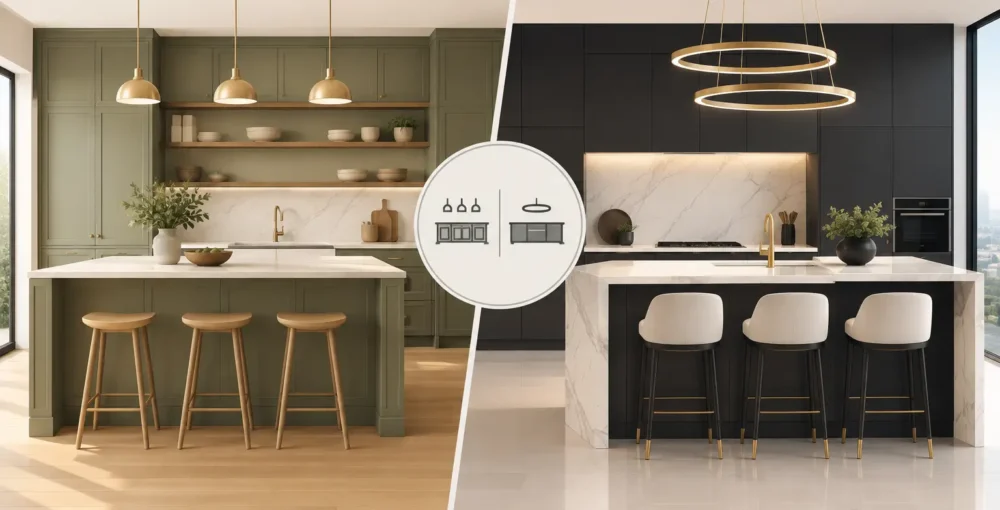
A kitchen can be finished in rare stone, fitted with prestigious appliances, and detailed in richly figured timber – yet still feel interchangeable. That distinction sits at the heart of bespoke kitchens vs luxury kitchens. Both may belong in exceptional residences, but they begin with very different ambitions: one elevates a proven model; the other creates an original work around a particular life, architecture, and point of view.
For a collector, homeowner, architect, or developer shaping a singular property, the difference is not semantic. It affects proportion, material expression, privacy, authorship, and the lasting identity of the interior.
Bespoke Kitchens vs Luxury Kitchens: The Essential Difference
A luxury kitchen generally refers to a high-end kitchen defined by superior materials, refined finishes, recognized appliance brands, and elevated detailing. It may offer extensive choices in cabinet fronts, hardware, countertop stones, internal fittings, and configurations. At its best, it is beautifully engineered and expertly installed.
A bespoke kitchen goes further. It is conceived specifically for one space and one client, rather than selected from a premium system and adjusted at the edges. Its dimensions, rhythm, volume, material palette, and functional rituals are authored from the beginning. The kitchen becomes part architecture, part furniture, and part sculptural object.
This does not mean every bespoke kitchen must be visually dramatic, nor that every luxury kitchen lacks character. A discreet apartment may call for a kitchen that appears as a calm monolithic wall, with no visible handles and almost no visual interruption. The bespoke quality lies in the precision of that restraint: the exact depth of a reveal, the grain alignment across a long elevation, the way a curved island changes movement through the room, or the choice to conceal every operational element behind a single continuous surface.
Luxury describes a level of quality and desirability. Bespoke describes an authorship process. The two can overlap, but they are not interchangeable.
When Luxury Is a Curated System
There is real value in a luxury kitchen from an established manufacturer. Its vocabulary has usually been refined through years of development: cabinet engineering is tested, accessories are considered, finishes are reliable, and installation follows a known process. For projects with a defined timeline, a clear layout, and a preference for an identifiable design language, this can be the intelligent choice.
A premium system can also offer substantial personalization. Clients may choose lacquer colors, natural veneers, stone surfaces, metal trims, and sophisticated appliance compositions. In a secondary residence, a development project, or a home where the kitchen must coordinate quietly with a larger interior scheme, that degree of choice may be entirely sufficient.
The limitation appears when the room refuses standard logic. Historic London townhouses, penthouses with sweeping glazed walls, coastal residences exposed to intense light, and villas with unusual structural geometry often require more than a collection of modules can gracefully provide. Filler panels and compromises may solve practical issues, but they rarely create the composed stillness expected in a truly exceptional interior.
The Bespoke Kitchen as an Architectural Object
A bespoke kitchen is not simply custom cabinetry in an expensive finish. It is an exercise in composition. Before material is selected, the atelier considers what the kitchen should be within the home: a convivial center, a private culinary laboratory, a gallery-like object, or a sculptural threshold between living and dining.
That question shapes everything that follows. An island may become a low, softly curved volume that invites conversation rather than behaving as a rectilinear workstation. A tall storage wall may be recessed to preserve the original proportions of a room. A hand-finished metal skin can catch evening light differently across its surface, giving the kitchen a presence that changes throughout the day.
In this context, function is not sacrificed to art. It is edited into the form. Drawers open where the hand naturally falls. Preparation surfaces appear at the right height and disappear when the room returns to a more formal mode. Ventilation, refrigeration, and small appliances are integrated without allowing machinery to dictate the visual language.
The most successful bespoke kitchens make these decisions feel inevitable. Their complexity is held behind an impression of ease.
Material Experimentation Creates Rarity
Material is often the clearest dividing line. A luxury kitchen may offer exquisite marble, walnut, brass, or lacquer from a well-developed sample library. A bespoke atelier can treat material as a field of invention.
This may involve a custom patina developed for a bronze surface, a composite formulated for a particular tactile effect, or an unexpected meeting of honed stone and hand-worked timber. It may mean selecting a slab not only for its color but for the movement of its veining, then placing every cut so that the material reads as a continuous landscape across the island.
Such work requires control from concept through fabrication. The designer must understand what a material can become in the hands of makers, and the makers must preserve the original intention through every join, curve, and finish. At Cedrimartini, this internal dialogue between design and production is central to the creation of limited and one-of-a-kind pieces. It allows the kitchen to carry the same material intensity as a collectible sculptural object.
Proportion Cannot Be Chosen From a Catalog
Standard cabinetry is based on rational increments. Bespoke work can honor the specific scale of a space instead. This matters especially in rooms with grand ceiling heights, irregular footprints, existing moldings, or architectural views worth protecting.
A few centimeters can change the perceived weight of an island. The radius of a curved end panel can determine whether it feels ornamental or naturally formed. Even the shadow line beneath a countertop influences whether a kitchen reads as furniture, architecture, or equipment.
This level of calibration is why a bespoke kitchen is often best developed alongside the architecture and interior design, rather than introduced after the room has been resolved. It belongs to the composition from the outset.
Cost, Lead Time, and the Value of Authorship
Bespoke is not automatically the right choice for every project. It involves a more involved design process, longer decision-making, specialist prototyping where needed, and a budget that reflects original development and hand fabrication. A luxury system can deliver remarkable quality with more predictable pricing and a more established production schedule.
The relevant question is not whether bespoke costs more. It is whether the kitchen is expected to do more. If it must solve an unusual architectural condition, express a private aesthetic that cannot be purchased elsewhere, or stand beside significant art and collectible furniture without becoming generic, bespoke may offer value far beyond specification.
Its value also includes discretion. For clients who prefer their home not to resemble a showroom or a recognizable project elsewhere, a one-of-one design offers a form of quiet distinction. The result is not merely scarce because it is expensive. It is rare because it belongs precisely to its owner and its setting.
How to Decide Which Approach Fits
Begin with the role the kitchen will play. If it is primarily a highly refined working room within a project with conventional dimensions, a luxury kitchen may meet the brief beautifully. Invest attention in the quality of the installation, the honesty of materials, and the relationship between the kitchen and surrounding architecture.
If the kitchen is intended to be the visual and social anchor of the residence, ask for a more authored process. Consider how the room is entered, where guests gather, what should be concealed, and what deserves to be seen. Think beyond finishes toward silhouette, mass, touch, and atmosphere.
It is also useful to establish where compromise is acceptable. An original kitchen does not require custom development of every unseen component. Bespoke excellence is often most powerful when it concentrates craftsmanship where it matters: the principal volumes, the material transitions, the visible edges, and the gestures that define the room. Proven technical components can remain discreetly behind the artistry.
A kitchen deserves to be chosen with the same discernment as a work of art or a commissioned piece of furniture. The right decision is the one that makes the room feel not simply expensive, but wholly its own.