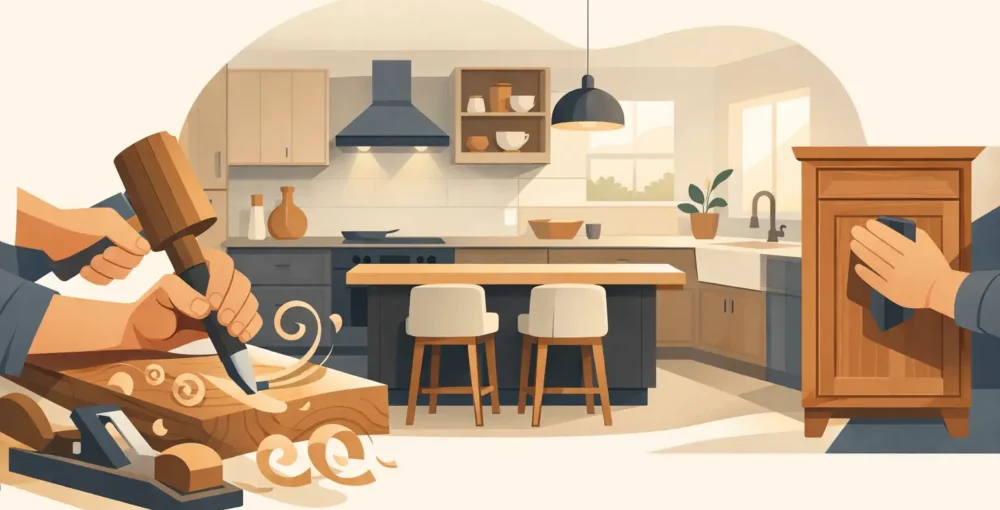
A serious kitchen is never just a place to cook. In the best homes, it becomes the room where architecture softens into ritual – morning light across stone, a hand-finished island that reads like sculpture, cabinetry with the quiet authority of a tailored interior. That is where artisan kitchen design furniture holds its value. It does more than furnish a kitchen. It gives the space identity, permanence, and a level of authorship that standard luxury cannot imitate.
For clients who have already moved beyond catalog decisions, the question is rarely whether a kitchen should be bespoke. The real question is what kind of bespoke it should be. There is a difference between expensive cabinetry and a kitchen composed as a collectible interior. The former answers function. The latter shapes atmosphere, movement, and visual memory.
What defines artisan kitchen design furniture
The phrase is often used too loosely. True artisan kitchen design furniture is not simply handmade in a generic sense, nor is it a decorative layer added to a technical kitchen system. It begins with authorship. Each element is conceived as part of an integrated composition, with proportion, material behavior, and tactile presence considered from the first sketch.
Its quality is visible in the details that cannot be rushed – softened edges, hand-worked finishes, curved volumes resolved without strain, and surfaces that reveal depth rather than uniformity. Wood grain is selected, not printed. Metal is patinated with intention. Stone is treated as a living material with weight, movement, and veining, not as a flat backdrop.
There is also a philosophical distinction. Mass luxury aims for consistency across many homes. Artisan work accepts nuance, because nuance is where character lives. Slight variations in finish, hand-shaped transitions, and custom joins are not flaws. They are evidence that human intelligence remained present throughout the making.
Why the kitchen has become a collectible interior
Over the last decade, the kitchen has shifted from a purely service-led room into the emotional center of the residence. In London townhouses, coastal estates, penthouses, and private compounds alike, it now carries the same visual expectations once reserved for the salon or gallery-like living room.
That change has raised the standard. Owners and design professionals no longer want a kitchen hidden behind polished claims of performance alone. They want a room that can hold sculptural furniture, rare materials, and architectural presence without sacrificing utility. They want the island to command the room. They want storage to disappear into a refined envelope. They want seating, surfaces, and millwork to feel composed rather than assembled.
This is why artisan kitchen design furniture matters now more than ever. It allows the kitchen to operate on two levels at once – as a high-functioning environment and as a highly personal expression of taste. For a collector or discerning homeowner, that duality is essential.
The role of material experimentation
In exceptional kitchens, material choice does far more than signal budget. It shapes mood. A deeply brushed oak brings warmth and gravity. Cast bronze introduces density and shadow. Hand-finished lacquer catches light with a softness that factory gloss rarely achieves. Stone with expressive movement can make a monolithic island feel almost geological.
What distinguishes an atelier approach is the willingness to test combinations that are less obvious and more refined. Resin against marble. Burnished metal beside open-grain timber. Softly curved forms wrapped in surfaces that reveal their depth over time. These decisions are rarely made from samples alone. They emerge through experimentation, mockups, and a trained understanding of how materials age, react, and converse with one another.
This process matters because kitchens endure close contact. Hands touch every edge. Heat, moisture, and use are constant. A beautiful material is not enough. It must also be chosen intelligently for the rhythm of the room. Sometimes the most dramatic finish belongs on a statement volume rather than a working surface. Sometimes restraint creates the greater luxury.
Bespoke means more than custom dimensions
Many kitchens are described as custom when they simply adapt standard components to a room. Genuine bespoke work goes much further. It responds not only to dimensions, but to architecture, lifestyle, privacy, and the emotional register a client wants the space to carry.
A family kitchen in a primary residence may need generosity and resilience without losing visual refinement. A city apartment may call for a more edited composition, where every cabinet line is precise and every reflection controlled. A hospitality setting may require theatrical impact from the first glance, balanced with circulation and service demands.
When furniture is developed at this level, the process becomes deeply collaborative. Designers, artisans, and clients are not choosing modules. They are defining presence. The radius of a corner, the exact height of an island, the weight of a door, the way a finish changes from daylight to evening – these become central decisions because they determine how the room feels to inhabit.
Artisan kitchen design furniture and the power of form
Form is often overlooked in kitchen planning because so much attention goes to appliances and storage. Yet form is what separates a premium kitchen from one that feels truly rare. Straight lines can be elegant, but they are not the only language of refinement. Curved silhouettes, sculpted ends, rounded monoliths, and softened architectural transitions can give the kitchen a calmer, more sensual presence.
This is especially true in open-plan interiors, where the kitchen must hold its own against art, seating, and architectural volumes. Furniture with organic form can mediate between hard building lines and domestic life. It softens the technical nature of the room without making it decorative or fragile.
There is, however, a balance to maintain. Strong sculptural form must still support use. A dramatic island should not compromise movement. A curved cabinet should not reduce storage beyond reason. The best work resolves this tension so naturally that the room feels inevitable.
Privacy, provenance, and internal control
For elite residential clients and top-tier design professionals, discretion is not an extra. It is part of the service. This is one of the strongest arguments for working with a design house that controls both design and fabrication internally.
When authorship and production remain under one roof, the result is usually more coherent. Details are not diluted through layers of outsourcing. Material intent remains intact. Adjustments can be made with fluency because the makers understand the concept at its source. Equally important, the client experience becomes more private, more controlled, and more trustworthy.
In the world of artisan kitchen design furniture, provenance carries weight. Knowing where a piece was conceived, who made it, and how it was finished adds cultural and emotional value. For some clients, that provenance matters as much as the object itself. It assures them that what they are commissioning is not merely expensive, but singular.
How to judge quality beyond appearances
Luxury kitchens are full of persuasive visuals. Renderings are polished. Showrooms are flattering. But enduring quality reveals itself elsewhere.
Look first at transitions. Are stone, wood, and metal meeting one another with confidence, or with concealment? Study the edges. A refined edge has intention, whether crisp or softened. Open and close doors and drawers. Weight and silence tell their own story. Ask how finishes are developed and whether they are truly hand-applied or simply marketed that way.
Most of all, ask whether the room has a point of view. A kitchen with no authorship may still be costly, but it will rarely become memorable. The best interiors carry a sense of inevitability, as though every plane, finish, and volume belongs exactly where it is.
For clients seeking that level of distinction, ateliers such as Cedrimartini offer something increasingly rare – not just manufacture, but artistic control. The kitchen becomes part furnishing, part sculpture, part architectural gesture.
Choosing a kitchen at this level is less about chasing trends than about commissioning a room with cultural weight. The finest spaces do not plead for attention. They hold it quietly, through material intelligence, measured form, and the unmistakable confidence of something made by hand and made to endure. If a kitchen is where daily life returns again and again, it deserves furniture equal to that ritual.