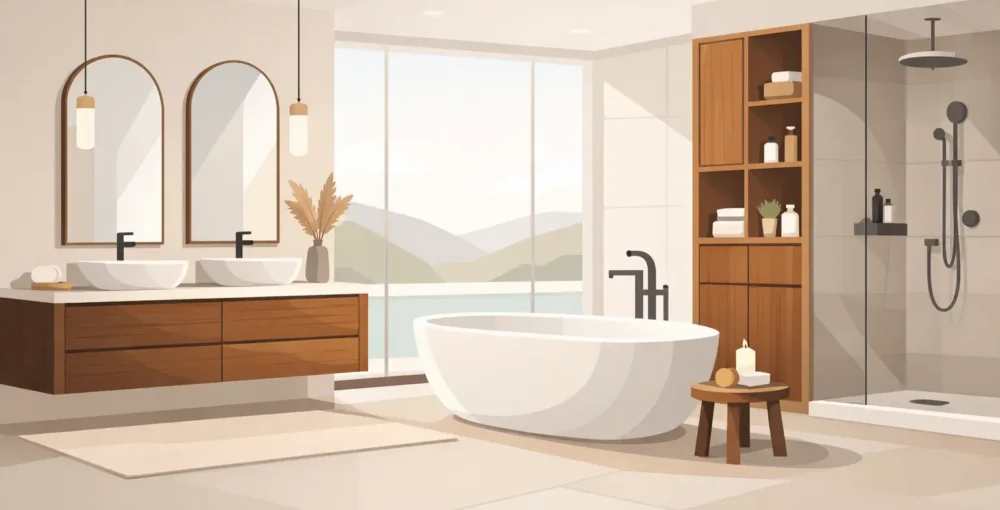
A remarkable bathroom is rarely defined by square footage. It is defined by restraint, proportion, and the presence of objects made with intention. Bespoke luxury bathroom furniture belongs in that rare category of design where utility is only the beginning. The vanity, storage volume, mirror surround, or sculptural seating element must perform flawlessly, but it must also alter the atmosphere of the room – quietly, decisively, and without compromise.
For private clients and design professionals, that distinction matters. The bathroom has moved well beyond a purely functional space. In a primary residence, penthouse, private spa suite, or hospitality setting, it has become one of the most intimate expressions of taste. Off-the-shelf solutions, however polished, tend to reveal their limits quickly. Standard dimensions flatten the architecture. Predictable finishes dilute character. And repetition is the opposite of luxury when exclusivity is the goal.
What bespoke luxury bathroom furniture really means
True bespoke work does not begin with a catalog and a set of minor adjustments. It begins with the room, the client, and the architectural intention. That may mean a vanity shaped to follow a curved wall, a monolithic storage piece balanced against heavy stone, or a composition that introduces warmth into an otherwise mineral environment.
In this context, luxury is not excess. It is precision. It is the ability to determine exact height, depth, silhouette, and finish so the furniture feels inevitable within the space. A bespoke piece can respond to sightlines from the bedroom, to the changing light across polished surfaces, or to the need for hidden storage that preserves visual calm.
That is the difference between customization and authorship. Customization modifies. Bespoke design composes.
Why the bathroom demands a different design language
Bathrooms are technically demanding rooms, but the challenge is not purely technical. Moisture, heat variation, and daily use set strict conditions, yet the emotional expectation is equally high. The room must feel restorative, composed, and private. Furniture in this setting has to negotiate performance and atmosphere at once.
A successful piece does not fight with the architecture or compete with the stone. It mediates. Curved forms can soften hard surfaces. Deeply figured wood can bring tactility to glass and marble. Cast or hand-finished materials can introduce subtle irregularities that make the room feel human rather than clinical.
This is where many luxury bathrooms fail. They are expensive, but not resolved. Every surface may be premium, yet the room lacks coherence because the furnishings were selected as products rather than conceived as part of a single design gesture.
The role of proportion and visual weight
Proportion is often what separates an adequate bathroom from an exceptional one. A vanity that is too slender beneath a monumental mirror wall will feel temporary. One that is too heavy in a compact room will dominate rather than anchor. Bespoke work allows visual weight to be calibrated with far greater sensitivity.
Floating forms create lightness, but they are not always the right answer. In some interiors, a grounded volume with a sculptural base gives the room a stronger architectural presence. In others, open space beneath the piece is essential to preserve serenity. There is no universal formula. It depends on the room, the adjoining materials, and the client’s preferred balance between statement and stillness.
Materials in bespoke luxury bathroom furniture
Material selection is where luxury becomes tangible. In the bathroom, however, beautiful materials are not enough. They need to age with dignity and perform under stress. The most compelling bespoke furniture often relies on contrast: solid and reflective, smooth and textured, warm and cool.
Natural stone remains a commanding choice, particularly when used with restraint. A carved or integrated stone top has gravity and permanence, yet too much stone can make the room feel severe. Wood introduces warmth, but species, treatment, and finishing must be considered carefully in humid conditions. Lacquered surfaces can read beautifully in lower light and offer a cleaner visual field, though they demand exceptional execution if they are to feel truly luxurious rather than merely glossy.
Metal details are often where refinement becomes visible. A discreet bronze line, a hand-finished brass edge, or a precisely integrated pull can shift a piece from competent to collectible. These decisions are rarely loud. Their effect comes from confidence and control.
Why experimentation matters
The most distinguished ateliers do not treat materials as fixed categories. They test them, combine them, and push them toward new expressions. That might mean pairing a matte mineral surface with highly figured timber, or developing a finish that reveals depth rather than shine. Material experimentation is not decoration. It is part of the design intelligence of the piece.
For clients seeking absolute exclusivity, this matters deeply. When surfaces, forms, and construction methods are developed internally rather than selected from standard industry options, the result is not simply rare. It is unrepeatable in any meaningful sense.
Bespoke luxury bathroom furniture for architects and private clients
For architects and interior designers, bespoke furniture offers control over the entire composition. It resolves awkward conditions that standard products cannot. It aligns millimetric detail with the architecture. It protects the design concept from compromise late in the process.
For private clients, the value is slightly different. It lies in authorship, privacy, and the assurance that the finished environment will not be mirrored elsewhere. A bathroom furnished with one-of-a-kind pieces carries a different emotional charge. It feels collected rather than purchased.
This is particularly relevant in markets such as London, New York, Miami, and Los Angeles, where luxury interiors are expected to communicate identity as clearly as comfort. In these contexts, repetition is instantly visible. Bespoke work resists that sameness.
The case for internal design and fabrication
One of the quiet luxuries in any commission is control. When design, prototyping, material development, and fabrication are managed within a single atelier, decisions remain coherent. The object that is conceived is far more likely to be the object that is delivered.
This matters in bathrooms because detail tolerances are unforgiving. Junctions with stone, wall finishes, integrated lighting, and concealed storage all require discipline. A fragmented production chain often introduces compromise. An internally controlled process protects intent, quality, and discretion.
Cedrimartini approaches this territory with the sensibility of both designer and maker, which is why its bathroom pieces feel authored rather than assembled. That distinction is subtle to some, immediately visible to others, and essential to those who live with exceptional design every day.
Trade-offs worth considering
Bespoke work is not for every timeline or every temperament. It asks for decisions to be made with care, and it rewards clients who value process as much as outcome. Lead times are naturally longer than with standard luxury brands. Material testing and prototyping may extend the schedule, especially when the design moves beyond familiar forms.
There is also a financial truth to acknowledge. Bespoke furniture costs more, not simply because it is handmade, but because originality, technical resolution, and low-volume fabrication carry real value. For many clients, that premium is entirely justified. For others, a hybrid approach works better, reserving bespoke design for the room’s defining pieces while simplifying secondary elements.
How to recognize quality in bespoke bathroom design
The strongest pieces do not announce their complexity. They feel calm. Drawers close with precision. Interiors are considered as carefully as exteriors. The silhouette remains convincing from every angle. Finishes have depth, not cosmetic gloss. Hardware, if visible at all, feels integral to the form.
Most of all, the furniture belongs to the room. It neither disappears nor shouts. It creates a sense that the architecture has been completed rather than decorated.
That is the standard worth pursuing. In a truly exceptional bathroom, furniture is not there to fill space. It establishes rhythm, permanence, and character. It supports private ritual while carrying the presence of art.
When that balance is achieved, the room acquires something rarer than luxury. It acquires identity. And that is what endures long after finishes, trends, and fashion cycles have receded.