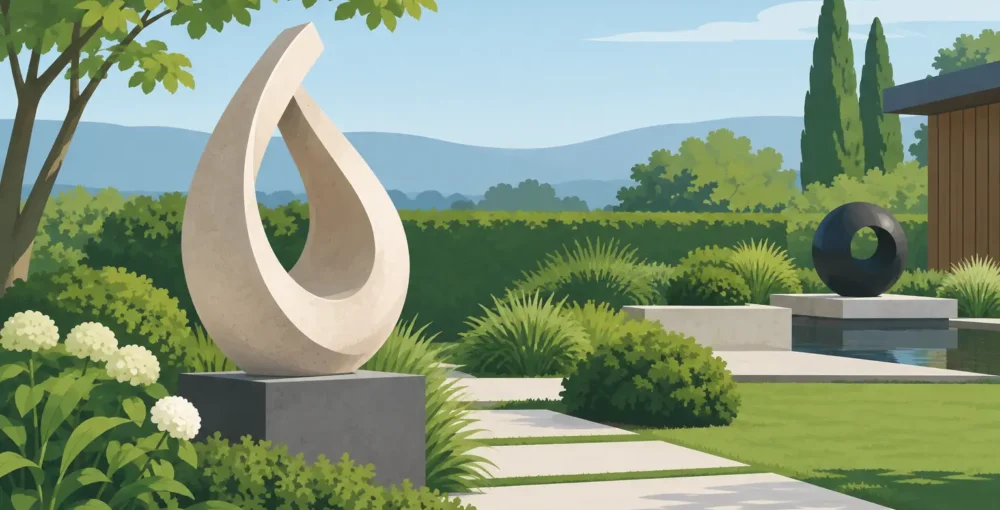
A garden rarely needs more decoration. What it needs is a point of gravity. Garden sculptures provide that center: an object with enough presence to hold its own against mature trees, shifting light, textured stone, and the seasonal abundance of planting. At their best, they do not interrupt a landscape. They give it a memorable rhythm.
For a private residence, hospitality project, or considered urban terrace, sculpture belongs in the earliest design conversation. It should not arrive as a finishing gesture after the paths, borders, and furnishings are complete. A well-conceived work can establish an axis, frame a distant view, create pause along a walk, or turn an otherwise transitional space into a destination.
Garden Sculptures as Spatial Architecture
The most compelling outdoor sculpture does more than occupy an empty corner. It changes the experience of moving through a garden. A tall vertical form can draw the eye through a long lawn; a low, expansive volume can anchor a reflecting pool or stone terrace; a curved object can soften the strict geometry of formal architecture.
Scale is central, but scale is not simply about making a piece large. A modest work placed at the end of a narrow path may feel monumental because the journey toward it is controlled. Conversely, an oversized object in an open landscape can appear strangely isolated if it has no relationship to surrounding levels, planting masses, or architecture.
This is why a sculpture should be considered from several distances. From the house, it may read as a silhouette. Along the path, its surface and edge become more apparent. At close range, the work reveals the hand of the maker: the tension of a curve, the depth of a patina, a seam deliberately retained as evidence of process. A collectible object rewards every approach.
Establishing a Focal Point Without Forcing One
A focal point should feel inevitable rather than theatrical. In a restrained garden, a single sculptural presence may be all that is required. It could sit beyond a clipped hedge, rise from gravel, or emerge partly from tall ornamental grasses. The setting gives the object a degree of concealment, then allows it to be discovered.
In larger grounds, several works may create a sequence, but repetition requires discipline. Pieces do not need to match. They do need a shared visual logic, whether through material, proportion, contour, or a recurring dialogue with water and stone. Too many unrelated objects can make even an expensive landscape feel like a display rather than a composition.
Materials That Age With Intention
The outdoor setting is not neutral. Rain, frost, sunlight, salt air, irrigation, and urban pollution all alter a material over time. This is not a reason to avoid expressive finishes. It is a reason to select them with foresight.
Bronze develops a living patina, gaining depth through contact with weather and air. Stone offers permanence, but its character varies dramatically: a pale limestone may take on softness and moss, while a dense dark stone creates a more graphic contrast against foliage. Stainless steel can bring reflection and clarity, though it asks for careful positioning so the glare of direct sun does not overwhelm the garden. Treated metals, ceramic, resin-based composites, and experimental mineral surfaces can each be appropriate when their aging process has been understood from the outset.
Material choice also affects the emotional temperature of the setting. A hand-finished bronze form can make a newly planted garden feel established. A polished, light-responsive surface introduces an almost immaterial quality, mirroring clouds, water, and leaves in motion. A rougher, mineral object can feel excavated from the site itself.
The question is not whether a material will change. Every exterior material changes. The question is whether that change will deepen the work’s character or diminish its intended presence.
The Value of Surface and Shadow
Outdoor sculpture is never viewed under gallery lighting alone. Morning can reveal a softly worked texture that disappears in midday brightness. Late-afternoon sun may lengthen a cast shadow until it becomes part of the composition. Rain darkens stone, emphasizes relief, and turns a matte surface more saturated.
For this reason, a highly polished finish is not automatically more luxurious than a textured one. Polished metal may offer a vivid, contemporary statement beside precise architecture and water. Yet a matte or hand-worked surface often gives a form greater depth in changing conditions. It holds shadow. It creates intimacy. It can feel especially persuasive in gardens designed for quiet observation rather than spectacle.
Placement Is an Act of Editing
The most refined landscapes leave room around their important objects. A garden sculpture gains authority through negative space: a margin of gravel, a calm plane of lawn, a pool of water, or a disciplined mass of planting that allows its outline to remain legible.
Placement should respond to sightlines from the rooms that matter most. Consider the view from the primary living space, the dining table, a bedroom terrace, and the approach to the house. A sculpture seen through a large window becomes part of the interior composition, particularly at night when carefully controlled exterior lighting carries the eye outward.
It also helps to consider what lies behind the work. Dense evergreen planting can make a pale or reflective form appear sharper. An open horizon can flatter a strong silhouette. A heavily detailed sculpture may be lost against visually busy foliage, while a simple, continuous volume can remain powerful there.
There are practical considerations as well. Foundations must suit the weight and dimensions of the piece. Drainage should protect both base and surrounding paving. In public-facing gardens or family properties, sharp edges, climbing opportunities, and routes of movement deserve thoughtful review. These are not limitations on artistic ambition. They are part of making a permanent work belong to its site.
Bespoke Work Makes the Garden Irreplaceable
A commissioned sculpture offers something a selected ready-made piece cannot always provide: a form conceived for a particular horizon, architectural language, climate, and way of life. The curve of a work might echo a staircase inside the residence, the profile of a nearby roofline, or the geometry of a courtyard wall. Its finish may be developed to converse with local stone, brushed metal details, or the color of a swimming pool.
For clients seeking absolute exclusivity, this relationship between object and setting is essential. The work becomes inseparable from the property. It cannot be reproduced as a generic decorative gesture because its dimensions, surface, and visual role were developed for one place.
At Cedrimartini, this approach begins with form and material as one conversation. Designed and handmade in Italy, a sculptural object can evolve through drawing, maquette, material trials, and the close study of how light will meet its surface. The result is not simply an exterior furnishing. It is a design artifact with a precise role in the life of the landscape.
Let the Garden Change the Work
The most enduring garden sculptures are not static in experience, even when they are physically immovable. Leaves cast new patterns across them. Flowering cycles alter their backdrop. Winter strips the garden to line and silhouette, often making the object more pronounced than it is in summer. A fine work accepts these changes without becoming secondary to them.
Resist the impulse to fill every view immediately. Live with the garden’s empty spaces long enough to understand where the eye naturally pauses, where the architecture needs counterweight, and where a sculptural gesture can make the landscape feel unmistakably its own.