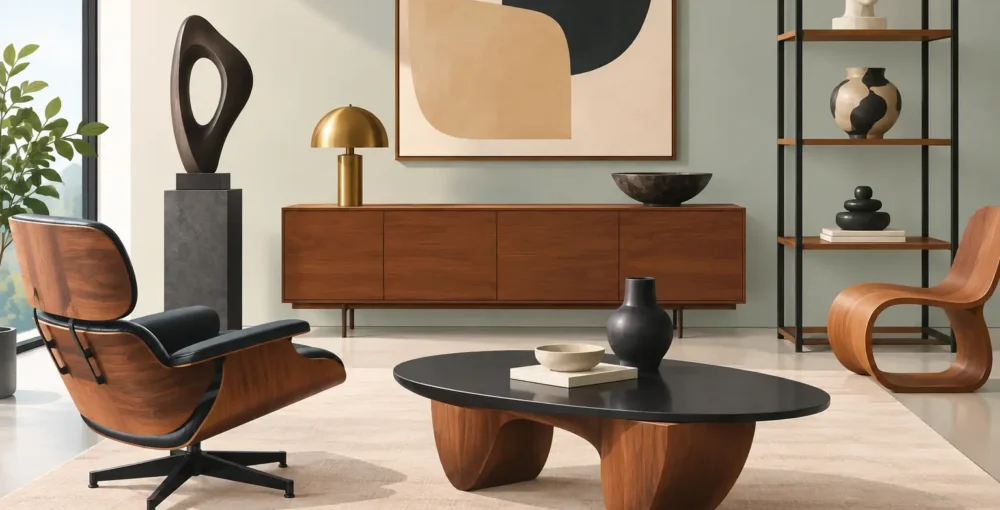
A room changes the moment its most functional object is allowed to behave like art. The finest interior art furniture examples do not merely fill a plan or match a palette. They establish gravity: a hand-formed console that holds a corridor in silence, a monumental table that turns dining into ceremony, or a sculptural seat whose profile remains vivid even when unoccupied.
For collectors and discerning homeowners, this is not an argument for decoration at the expense of comfort. It is an argument for choosing objects with a point of view. Art furniture asks more of its maker and its owner. It must perform, endure, and reward sustained attention, while carrying the unmistakable presence of a singular work.
What Makes Furniture an Interior Artwork?
The distinction is not simply rarity, price, or an unusual silhouette. A collectible piece becomes interior art when its artistic intention is inseparable from its function. Its form may be guided by the movement of water, the density of stone, the tension of a folded metal surface, or the warm irregularity of hand-worked wood. Yet it still receives the body, supports a ritual, and belongs to the architecture around it.
Material is central to that transformation. In conventional furniture, finishes are often selected after a form has been resolved. In art furniture, material can be the origin of the idea. A vein in marble may direct the composition of a table. Cast bronze can preserve the trace of the maker’s hand. Lacquer, resin, parchment, and patinated metal can create depth that shifts as daylight moves through a room.
Scale matters as well. An artistic object need not dominate every view to be powerful. A low, quietly irregular bench may bring more distinction to a gallery-like hall than a large decorative installation. The successful piece has enough visual authority to hold its own, but enough discipline to let the residence remain livable.
Interior Art Furniture Examples That Define a Room
A sculptural dining table
The dining table is perhaps the most convincing expression of functional art because it occupies the center of shared life. A base shaped as a continuous organic volume, paired with a finely finished stone, glass, or timber top, can read as sculpture from every angle. Its value lies in the encounter between mass and use: the table must appear considered from a distance, while offering generous clearance, balance, and comfort at close range.
For a formal residence, a long table in carved wood or mineral composite can command a dining room without relying on ornate surrounding decoration. In a more contemporary setting, a round or elliptical composition softens architectural lines and encourages a more intimate gathering. The important question is not whether the table is dramatic. It is whether its drama improves the room’s ritual.
A console as a threshold object
A console is often the first object one encounters inside a private home, making it an ideal place for a more expressive gesture. Rather than treating it as a narrow surface for keys and flowers, consider a piece with a deeply modeled base, an asymmetrical profile, or a finish that reveals layers of hand-applied color.
In an entry hall, the console should create anticipation rather than visual noise. A quiet, monolithic form can be especially effective against plaster, travertine, or dark timber paneling. Its presence announces the level of care within the home before a single room has been entered.
The chair as a collectible character
A chair is intimate by nature. It meets the body, frames posture, and is seen in close detail. This makes it one of the most demanding forms in collectible design. A chair may have the stance of a small architectural structure or the softness of a carved pebble, but proportion cannot be sacrificed to novelty.
A pair of sculptural lounge chairs can anchor a library, dressing room, or suite without the predictable symmetry of conventional occasional seating. In a larger salon, one exceptional chair may be more memorable than a complete set. The trade-off is visual intensity: where a room already contains strong art, patterned stone, or elaborate millwork, choose a chair with a restrained finish and a precise silhouette rather than competing ornament.
A coffee table with material presence
Coffee tables invite a different kind of attention. They are viewed from above, around, and at rest among books, flowers, and conversation. This makes them particularly suited to unusual surfaces: a polished metal plane with softened edges, a layered resin body, a hand-finished lacquer volume, or stone selected for its geological movement.
The strongest examples hold their identity even when styled minimally. A table should not require a dense arrangement of objects to become interesting. In fact, leaving part of its surface bare often gives the material and contour the dignity they deserve.
A screen that shapes light and privacy
A freestanding screen is one of the most poetic forms of interior art furniture. It can divide a room without closing it, conceal a private threshold, or filter light across a wall. When made with carved timber, perforated metal, translucent resin, or layered textiles, it becomes an active participant in the atmosphere of a space.
This is especially valuable in open-plan residences, where rooms need definition without losing their generosity. A custom screen can establish a dining area, soften a view toward a service zone, or create a private dressing moment within a principal suite. Its success depends on what it reveals as much as what it conceals.
A cabinet conceived as a sculptural volume
Storage is rarely celebrated, which is exactly why a bespoke cabinet can make such an impact. A credenza, bar cabinet, or armoire offers a broad field for artistic expression while solving a practical need. Doors can carry relief, curved fronts can alter the room’s rhythm, and interiors can be finished with the same care as the exterior.
For collectors, this category offers a rewarding balance. The object can be substantial enough to become a focal point, yet its usefulness prevents it from feeling ceremonial or remote. A cabinet commissioned for a particular wall also creates a level of integration that a standalone artwork may not achieve.
How to Place Art Furniture Without Overfilling a Room
Art furniture is strongest when it has room to breathe. A common mistake is to acquire several striking pieces and place them close together, diminishing the character of each. Treat every major work as an intentional pause in the visual sequence of the home.
Begin with the architecture. Observe sightlines from the entrance, the direction of natural light, ceiling height, and the transition between rooms. A sculptural table may be best revealed from a diagonal approach rather than head-on. A low seat may need a textured wall behind it to clarify its outline. The surrounding negative space is not emptiness. It is part of the composition.
Then consider hierarchy. One primary art-furniture piece per room is often enough, supported by quieter companions in related materials or tones. This does not mean every other element must disappear. It means the room should have a clear visual voice. In maximal interiors, the answer may be an object with simpler geometry but exceptional surface depth. In spare architecture, a more expressive contour can provide the necessary warmth and movement.
Light deserves early consideration. Daylight reveals patina, grain, translucency, and polish differently across the day. At night, low-angle lighting can emphasize a carved edge or cast a screen’s shadow across the floor. Lighting should reveal the object’s construction, not flatten it into a display piece.
Why Commissioning Changes the Result
The most resonant interior art furniture examples are often created for a specific setting. Commissioning allows scale, material, function, and visual weight to be resolved together rather than negotiated after purchase. A table can answer the proportions of a room. A console can follow the curve of a wall. A cabinet can accommodate a private collection, a hidden bar, or a particular stone surface already present in the architecture.
It also creates room for material experimentation. The client may be drawn to the warmth of oxidized metal, the tactility of brushed timber, or a finish developed through repeated layers of pigment and hand-polishing. In an atelier such as Cedrimartini, design and fabrication remain closely held, allowing the object to develop with rigor from early gesture to final surface.
This process is not about adding customization for its own sake. Too many gestures can weaken an object. The purpose is precision: a piece that could not be transferred unchanged to another residence because it belongs, materially and emotionally, to this one.
Choose the object that continues to reveal something after the room has become familiar. That is the quiet standard of art furniture: not a momentary spectacle, but a daily encounter with form, craft, and individual vision.