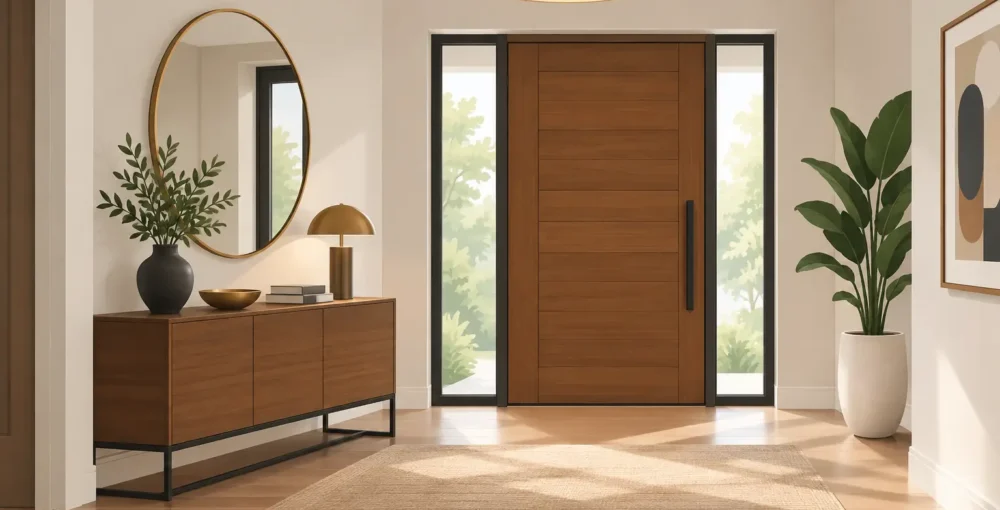
A home announces itself before a guest has crossed its threshold. The most compelling statement entrance furniture ideas do more than fill a foyer: they create a pause, direct the eye, and establish the level of intention found throughout the residence. In a private home, penthouse, or discreet hospitality setting, the entrance should feel composed rather than decorated – an encounter with form, material, and atmosphere.
The strongest schemes begin with one exceptional gesture. This may be a monolithic console cut in a richly veined stone, a low sculptural seat with a hand-finished surface, or an illuminated object that seems to alter the architecture around it. The objective is not abundance. It is presence.
Statement Entrance Furniture Ideas That Set the Tone
A sculptural console as the room’s anchor
The console remains the natural anchor for many entryways, but its purpose extends well beyond holding keys or correspondence. In a considered interior, it becomes a horizontal sculpture: a piece that introduces proportion, texture, and visual gravity against a wall or within an open-plan arrival space.
A curved console in patinated metal, lacquer, stone, or hand-worked wood can soften the rigid geometry of a corridor. A more architectural volume, meanwhile, gives a grand foyer clarity and restraint. The right choice depends on what the surrounding space asks for. Where the architecture is quiet and linear, an expressive organic form can supply tension. In a home already rich with arches, stonework, or ornamental detail, a console with a pure silhouette may be the more powerful decision.
Scale matters as much as material. A small piece placed on an expansive wall will feel tentative, however rare its finish. Conversely, an oversized console can constrict circulation. Allow generous breathing room around the piece, especially when it is conceived as a collectible object rather than ordinary furniture.
A bench that makes arrival feel deliberate
A bench offers the guest a moment of transition: a place to sit, remove shoes, place a bag, or simply absorb the room. Yet it should never read as a waiting-room convenience. In a luxury entrance, seating is an opportunity to introduce tactile contrast and human scale.
Consider a low, elongated bench in carved timber, upholstered leather, bouclé, or an experimental composite. Its lines can echo the architecture or deliberately resist it. A rounded seat beneath a sharply rectilinear staircase, for example, introduces a quiet dialogue between softness and structure.
Avoid treating the bench as an accessory to the console. If both pieces occupy the same entrance, they should have separate visual roles. One may be substantial and sculptural, while the other remains low and almost elemental. Matching every finish can make a space feel overly coordinated; a shared undertone in color, grain, or metal is often enough.
A pedestal for a singular object
Some entrances need less furniture, not more. A solitary pedestal can carry an object with the authority of a gallery installation: an abstract vessel, a hand-cast sculpture, a mineral formation, or a floral composition with dramatic scale. This approach is particularly effective in narrow halls and architecturally important vestibules where floor space is limited.
The pedestal should be treated as part of the composition, not a neutral support. A cylindrical plinth in a deep mineral finish may create stillness, while an asymmetric base can make the object and its shadow feel active from every angle. Lighting becomes essential here. A focused wash of light can reveal the tactile depth of a surface without turning the entrance into a display case.
This is also a refined answer for collectors who prefer to rotate works seasonally. The architecture stays serene while the entrance evolves through one chosen object.
Let Material Carry the Drama
In an entrance, the hand reaches surfaces before the eye has fully understood the room. The cool density of stone, the warmth of oiled wood, the softness of leather, and the irregular gleam of metal all shape the experience of arrival. Statement furniture succeeds when its material language feels intentional under close inspection.
Natural stone is compelling for its permanence, but it is not the only route to gravitas. Cast metals can carry a dark, almost liquid depth. Lacquer can capture and reflect light in a more controlled way. Wood can be ebonized, bleached, brushed, or hand-burnished to reveal a character that cannot be replicated by standard production. Material experimentation is most convincing when it has a reason within the wider home – a bronze detail may answer a stair rail, while a particular stone recalls the fireplace or bathing suite.
There is a practical side to this decision. Entry furniture encounters bags, umbrellas, packages, and daily use. Highly polished finishes may show marks more readily, while honed stone, patinated metal, and textured surfaces tend to age with greater generosity. A residence with young children or frequent entertaining may require a different finish strategy than a pied-à-terre used primarily for private weekends. Luxury is not fragility; the best pieces anticipate a life around them.
Use Lighting as Furniture, Not Decoration
A statement light can hold an entryway even when the footprint is modest. Suspended lighting works particularly well in double-height spaces, where a sculptural chandelier or cascading composition creates a vertical counterpoint to the floor plane. In lower ceilings, a wall-mounted luminous object can be equally theatrical without interrupting sightlines.
The key is to layer light rather than rely on a single dramatic fixture. Ambient illumination sets the mood, while concealed or directional light reveals the surface of a console, an artwork, or a textured wall. A mirror may amplify that glow, but it should not be placed automatically. In some entrances, a reflective plane adds depth and movement. In others, it doubles visual noise and weakens the impact of a primary piece.
Warm light is generally more forgiving to natural materials and complex finishes. The exact temperature, however, should be coordinated with the art, wall color, and daylight conditions rather than selected as an afterthought.
Compose the Entrance Like a Private Gallery
The most memorable entryways have a clear hierarchy. One piece leads. Everything else supports it through scale, negative space, and restraint. This principle is useful when choosing among statement entrance furniture ideas because it prevents a foyer from becoming a collection of competing gestures.
Start by deciding what should be seen first from the front door. It may be the silhouette of a console, a sculptural chair, an illuminated wall, or a framed view beyond the hall. Then consider the approach: what reveals itself only after a few steps? A well-placed side table, a recessed niche, or the reverse curve of a bench can reward movement through the space.
Symmetry offers ceremony, especially in formal residences. A centered console flanked by a pair of sculptural lamps or objects creates a composed, almost architectural welcome. Asymmetry feels more contemporary and can be more compelling in homes where the entrance opens directly into living areas. Neither approach is inherently superior. The decision should reflect the architecture and the owner’s relationship with order, art, and ritual.
For a commissioned interior, this is where bespoke design becomes invaluable. A piece made for a precise wall length, sightline, material palette, and mode of use carries an ease that cannot be achieved by forcing a ready-made object into place. At Cedrimartini, this control from concept through fabrication allows furniture to be considered as part of the interior’s architecture, with privacy and singularity preserved throughout the process.
Give the Room Permission to Breathe
An entrance is often asked to do too much: storage, seating, illumination, display, and circulation must coexist in a limited area. The answer is rarely to add another object. A single handmade console with an exceptional surface may be more memorable than a console, chair, mirror, lamp, and decorative arrangement competing for attention.
Keep practical necessities discreet. Concealed storage, an integrated drawer, or a tailored tray can manage everyday objects without compromising the composition. If the entrance must accommodate coats, shoes, or deliveries, let those functions occupy a secondary zone rather than the central visual field.
Choose one piece that feels impossible to find elsewhere, then allow space, light, and material to give it its full voice. That first encounter will make the rest of the home feel not merely furnished, but authored.