A yacht is not merely a residence placed on water. Its interiors must hold their composure through movement, salt air, changing light, and the close proximity of guests. The most persuasive yacht interior examples do not imitate a city penthouse or a resort suite. They create a distinct, protected world where every surface, proportion, and object earns its place.
For owners and designers, the question is rarely whether a room appears luxurious. It is whether it feels personal without becoming overworked, and whether its material language remains convincing after years of travel. The following interiors show how that balance can be achieved through restraint, sculptural presence, and a clear point of view.
Yacht Interior Examples With a Strong Point of View
1. The salon conceived as a sculptural landscape
A generous main salon offers the greatest opportunity for a yacht to declare its identity. Rather than filling the plan with conventional sofas and occasional tables, consider a low, curved seating composition that appears formed for the room itself. Its silhouette can guide sightlines toward the water, while a pair of monolithic lounge chairs introduces visual counterpoint.
The success of this approach depends on negative space. A salon becomes more imposing, not less, when there is room around a central object to appreciate its volume. A hand-finished coffee table in cast metal, carved stone, or lacquered wood can act as the room’s quiet anchor, particularly when its surface catches the shifting daylight without creating glare.
A palette of smoked oak, warm ivory upholstery, and deeply veined stone gives the space gravity. Yet material selection at sea requires discipline. Highly polished finishes can reveal every touch, and pale textiles demand exceptional performance. The answer is not to abandon refinement, but to specify finishes whose tactility improves with use: brushed metals, closed-grain woods, finely textured leathers, and wool blends engineered for marine conditions.
2. A dining room with the intimacy of a private club
The best yacht dining rooms avoid the formal stiffness of a land-based mansion. A long rectangular table can be magnificent, but it must leave adequate circulation when service is in motion and the vessel is underway. An oval or softly faceted tabletop often works better, softening the geometry of a narrow plan while allowing guests to face one another naturally.
Imagine a table with a bronzed, hand-patinated base and a top in dark mineral composite, edged with a narrow line of polished metal. Surround it with upholstered chairs whose backs have the presence of small sculptures. Above, a custom pendant installation may be composed as a suspended constellation rather than a single dominant fixture.
This is where light becomes theatrical in the best sense. At lunch, the room should receive daylight without being washed out. At night, the table should become the visual center, with illumination controlled closely enough to flatter food, faces, and materials. Discreet wall grazing can reveal a plaster finish or a hand-laid timber marquetry panel, adding depth without clutter.
3. An owner’s suite shaped for stillness
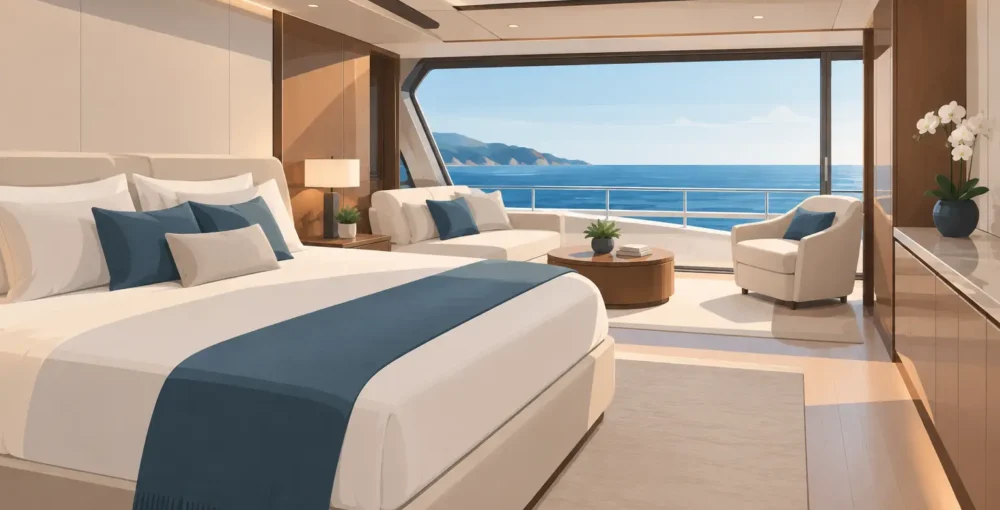
A yacht owner’s suite must serve several roles: retreat, dressing room, private salon, and place of rest. The strongest schemes treat the bed not as a piece of furniture placed against a wall, but as an architectural element. A deeply upholstered headboard that wraps into flanking panels can create a sense of enclosure, especially when integrated with reading lights and concealed storage.
An example might pair pale sycamore with saddle leather and a luminous, pearl-toned wall finish. The composition is restrained, but not anonymous. A carved bedside table with softened edges, a bronze-framed mirror, and a single collectible light object provide distinct moments of character.
Privacy is also sensory. Mechanical noise, hard reflections, and excessive visual detail can undermine even the most expensive room. Layered drapery, acoustic wall treatments, and low-gloss surfaces create a more serene experience than decoration alone. On a yacht, comfort is often the highest expression of luxury.
4. A dressing area treated as a jewel box
Dressing spaces are frequently reduced to practical cabinetry, despite their intimate role in the owner’s daily ritual. A more considered approach frames the area as a jewel box: fluted timber doors, softly illuminated niches, drawer interiors lined in suede, and a sculptural stool positioned before a full-height mirror.
The proportions should feel precise rather than crowded. Jewelry and watches deserve dedicated compartments, while wardrobe interiors benefit from lighting that reveals texture and color accurately. If the yacht is intended for long periods aboard, a seated vanity can be as valuable as additional hanging space.
This is an ideal place for material contrast. A dark timber exterior may open to a pale leather-lined interior, while hand-cast hardware gives each interaction a satisfying weight. Such details are not decorative afterthoughts. They make the room feel commissioned for one owner rather than supplied for any owner.
Beyond the Salon: The Rooms That Define a Yacht
5. A spa bathroom with elemental materials
The yacht bathroom has moved far beyond glossy marble and chrome. More compelling examples use stone, metal, glass, and timber in compositions that feel almost geological. A freestanding tub in honed stone composite, placed beneath a skylight or beside a privacy-screened window, can become the defining gesture of a suite.
Honed surfaces are particularly appropriate because they soften reflected light and feel less theatrical than mirror-polished stone. Pair them with aged brass, darkened bronze, or satin nickel, depending on the wider interior language. A fluted glass partition can divide the wet area while preserving light and creating a gentle sense of mystery.
There is a practical trade-off. Natural stone introduces weight, maintenance requirements, and structural considerations, while highly textured surfaces may be harder to clean in a marine environment. Material experimentation should therefore be guided by technical intelligence as much as visual ambition. The result should feel effortless, even when its fabrication is anything but.
6. Guest cabins with individual identities
Uniform guest cabins are efficient, but they can make a substantial yacht feel impersonal. Giving each cabin a distinct character creates a more memorable experience, provided all remain part of one coherent story. One room may center on midnight-blue lacquer and brushed pewter; another on sand-colored linen, pale oak, and handwoven textile panels.
The variation need not be dramatic. A change in accent stone, headboard textile, or bedside lighting can be enough. The underlying proportions, hardware language, and cabinetry quality should remain consistent, creating continuity across the vessel.
Guest rooms also demand clarity. Every drawer, charging point, reading light, and luggage position should be intuitive from the first night aboard. Sophistication is not found in forcing a guest to search for a switch. It lies in anticipating the gesture before it is made.
7. The exterior lounge as an extension of the interior
The boundary between interior and exterior is especially important on a yacht. An aft deck lounge should carry the same confidence as the salon while using materials capable of meeting direct sun, moisture, and wind. Sculptural outdoor seating, tailored cushions, and a substantial dining or cocktail table can establish the space as an open-air room rather than an arrangement of marine furniture.
Here, curved forms are particularly effective. They respond to the horizon, soften the technical lines of the vessel, and encourage conversation. A palette of mineral grays, tobacco, chalk, or deep green feels composed against sea and sky. Small accents in polished metal or colored glass can provide brilliance without resorting to excess.
A well-designed exterior also considers what happens after sunset. Low-level illumination at the base of seating, within steps, and around the perimeter should guide movement while preserving the darkness of the water. Brightness is not atmosphere. Control is atmosphere.
What Makes These Yacht Interiors Last
The enduring yacht interior is not built from an accumulation of expensive names or rare finishes. It is built from a hierarchy. One material may lead, another may provide contrast, and a small number of sculptural objects may hold the eye. When every surface asks for attention, the vessel loses its sense of calm.
This is why bespoke work matters. A handmade console can follow the exact curve of a bulkhead. A custom light can be scaled to a double-height void. A dining table can accommodate a particular style of entertaining while expressing the weight and tactility an owner wants to live with. At Cedrimartini, that level of authorship comes from keeping design and fabrication within the atelier, where proportion, finish, and privacy remain under close control.
The most valuable reference is not a copied room, but the emotional response it produces. Choose the yacht interior example that makes guests lower their voices, reach for a surface, and feel that they have entered a place that could belong to no one else.