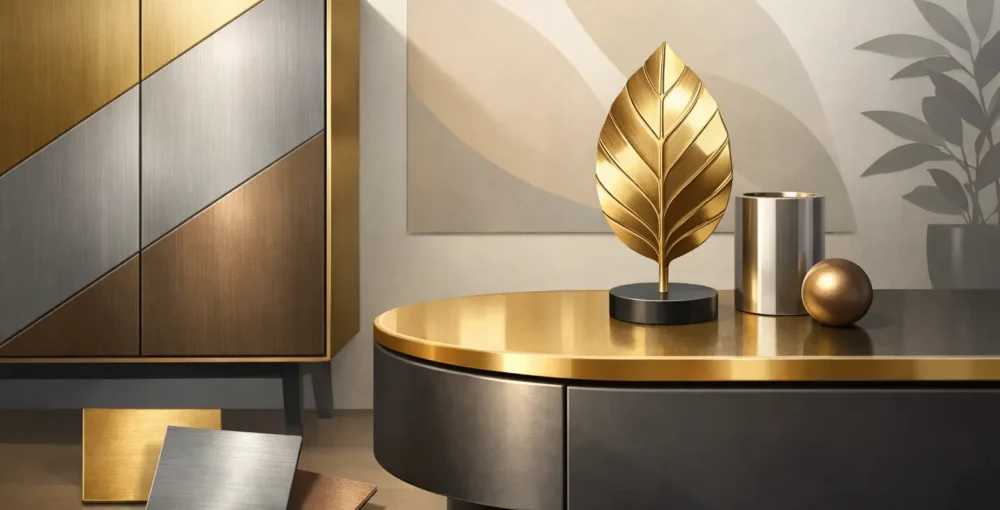
A room can be impeccably furnished and still feel incomplete until one surface changes the light. That is the particular power of a metallic leaf furniture finish. It does not simply add shine. It introduces atmosphere, movement, and a level of hand-applied refinement that reads immediately as rare.
In high-end interiors, finishes are never secondary. They are often the difference between a piece that occupies space and one that quietly commands it. Metallic leaf belongs to that second category. Whether applied in gold, silver, champagne, copper, or more nuanced custom tones, it gives furniture an almost architectural role, catching daylight, softening evening light, and creating a subtle tension between material richness and sculptural form.
What a metallic leaf furniture finish really is
Metallic leaf is a decorative finish created by applying ultrathin sheets of metal or metal-effect leaf by hand onto a prepared surface. The process sounds straightforward, yet the result depends entirely on expertise. The substrate must be perfectly balanced, the adhesive timed with precision, and the leaf laid with a sensitivity that allows the surface to feel continuous without becoming sterile.
That distinction matters. In a luxury context, a metallic leaf furniture finish should never look factory-flat or overly polished unless that effect is intentionally pursued. The beauty lies in nuance – the slight tonal shifts, the evidence of gesture, the soft irregularity that confirms the work was completed by skilled hands rather than by an automated line.
The finish can be brilliant and reflective, muted and velvety, or intentionally aged. It may read as luminous glamour in one setting and restrained mineral depth in another. Much depends on the underlying form, the scale of the object, and the atmosphere the interior is meant to create.
Why metallic leaf endures in collectible furniture
Some finishes follow trends. Metallic leaf has persisted because it speaks to something older and more lasting: the human attraction to light on crafted surfaces. Across centuries, gilded and silvered finishes have appeared in architecture, decorative arts, and ceremonial objects not simply as ornament, but as a way to give material presence a different order of significance.
In contemporary furniture, that heritage becomes more interesting, not less. A curved console, a sculptural cabinet, or a monolithic side table finished in leaf can feel both ancient and rigorously modern. The finish carries memory, while the form asserts immediacy. For collectors and designers, this is often the appeal. It creates a dialogue between artistry and function without forcing the piece into nostalgia.
There is also the matter of exclusivity. No two hand-applied leaf surfaces are ever perfectly identical. Even within the same commission, each panel or contour develops its own rhythm. For clients who value one-of-a-kind work, that individuality is not a flaw. It is the point.
Where a metallic leaf furniture finish works best
Not every object benefits from the same degree of visual intensity. Metallic leaf is at its most persuasive when the form deserves emphasis. Rounded profiles, carved volumes, faceted planes, and gently asymmetrical silhouettes all gain depth from the way leaf responds to light.
Cabinets and credenzas become more than storage when their surfaces shift throughout the day. Side tables and consoles gain a sculptural profile, especially in entrance halls or transitional spaces where a single object must establish tone quickly. In hospitality or residential projects with restrained palettes, metallic leaf can provide the focal point without introducing visual noise.
That said, scale matters. On a large piece, a very bright finish may dominate the room. On a smaller object, the same finish may feel like a precise accent. The right decision depends on whether the piece is intended to anchor the room, converse with surrounding materials, or operate as a quiet surprise. Luxury is rarely about adding more. It is about calibrating impact.
The difference between leaf, metallic paint, and plated surfaces
Clients often compare metallic leaf with metallic lacquer or plated metal details. The distinction is significant.
Metallic paint can be beautiful, but it usually delivers a more uniform effect. It tends to read as a surface treatment rather than a crafted skin. Plated metal, by contrast, can offer clarity and durability, yet it often feels colder and more industrial. Neither is inherently inferior. They simply create different emotional results.
A metallic leaf furniture finish offers a more complex visual field. Because the material is applied in sheets and then refined by hand, the surface catches and releases light unevenly. That slight irregularity creates warmth. It also gives the finish an intimacy that is difficult to replicate with sprayed coatings or machine-finished metals.
For bespoke interiors, that complexity is often the deciding factor. Designers are not merely selecting a color or sheen. They are choosing how a piece will live in the room, how it will register at close range, and how it will reveal itself over time.
The beauty of imperfection and patina
One of the most sophisticated qualities of metallic leaf is that it does not need to appear pristine to feel luxurious. In fact, a surface that is too perfect can lose some of its soul. The most compelling leaf finishes often include gentle tonal variation, softened edges, or a controlled patina that gives the object depth from the beginning.
This is where true craftsmanship separates itself from decorative imitation. An artisan understands how far to push the finish. Too little variation, and the result can feel generic. Too much aging, and the piece risks looking theatrical. The right balance creates a surface that feels settled, sensual, and believable.
For collectors, this quality is particularly valuable. A patinated metallic finish sits comfortably among stone, wood, plaster, lacquer, and textile. It does not scream for attention. It converses with the room.
Metallic leaf furniture finish in bespoke design
In a bespoke atelier, metallic leaf is not chosen in isolation. It is developed as part of a complete language of form, proportion, and material dialogue. A gold leaf exterior may require a darker interior finish to sharpen contrast. A silvered surface may be warmed with undertones that prevent it from feeling austere. A champagne leaf may be adjusted to sit comfortably beside travertine, smoked glass, or polished bronze.
This is why the process benefits from internal control. When design and fabrication remain under one roof, the finish is not an afterthought handed off at the end. It evolves with the piece. Curves can be refined to receive light more elegantly. Surface preparation can be tailored to the exact effect desired. Samples can be adjusted until the finish belongs fully to the object rather than merely covering it.
For architects and private clients commissioning statement furniture, that level of authorship is essential. It protects coherence. It also protects rarity, because the final result is shaped through direct experimentation rather than selected from a standard finish card.
Practical considerations for luxury interiors
For all its visual richness, metallic leaf is not suited to every use in the same way. A heavily used dining surface or a family kitchen piece may require additional protection or a different treatment altogether. In lower-contact applications, the finish can remain more delicate and expressive. In busier settings, the surface may need sealing strategies that slightly alter its tactile character.
This is not a limitation so much as a design decision. The question is never simply whether metallic leaf is durable enough. The better question is what kind of life the piece is expected to have. Is it a collectible object with ceremonial presence, or is it an everyday touchpoint? Both can be valid, but they call for different technical resolutions.
Maintenance is similarly nuanced. Gentle care preserves the finish best. Abrasive cleaning is out of the question, and overhandling should be considered during specification. Clients who invest in bespoke pieces generally understand this instinctively. A rare finish invites stewardship.
Cedrimartini approaches such surfaces as part of an alchemical laboratory of material experimentation, where finish, form, and atmosphere are developed as one. That is the difference between decoration and authorship.
Why the finish matters emotionally
The most memorable interiors are rarely built on scale alone. They are built on moments of perception – the cabinet that glows at dusk, the console that reflects candlelight in fragments, the sculptural object that changes character as you pass it. Metallic leaf excels in this territory because it is never static.
It gives furniture a living surface. Not animated in a theatrical sense, but responsive. Sensitive to light, to viewpoint, to the architecture around it. That responsiveness is what makes the finish feel luxurious in the deepest sense. It rewards attention.
For private residences and collector-led projects, this matters more than trend value. A metallic leaf furniture finish offers something quieter and more enduring: presence shaped by hand, and beauty that reveals itself in layers. If a piece is meant to be remembered rather than merely used, few finishes carry that responsibility with greater elegance.