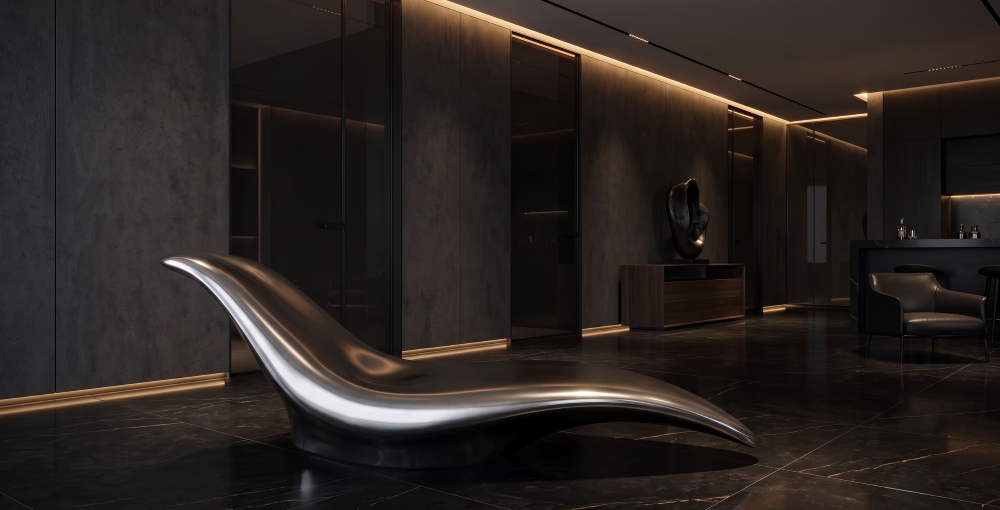
A room can be expensively furnished and still feel anonymous. The difference is rarely budget alone. It is authorship. The best bespoke contemporary furniture makers do not simply fill space with refined objects – they give an interior its point of view, shaping pieces that carry proportion, material depth, and a level of individuality that cannot be replicated off the shelf.
For private clients, architects, and developers working at the highest level, this distinction matters. A bespoke piece is not a decorative afterthought added once the shell is complete. It often becomes the element that clarifies the entire scheme: the dining table that sets the geometry of the room, the sculptural seating that softens severe architecture, the vanity or console that introduces a tactile counterpoint to stone, metal, and glass. When furniture is conceived this way, it behaves less like inventory and more like collectible design.
What bespoke contemporary furniture makers really offer
The term bespoke is often used loosely, especially in luxury interiors. In practice, there is a profound difference between modifying an existing model and commissioning an object from true bespoke contemporary furniture makers. The first is customization. The second is authorship, interpretation, and fabrication directed toward a singular result.
A serious atelier begins by reading the environment and the client. That means understanding scale, circulation, light, architectural rhythm, and the emotional register a room is meant to hold. A piece intended for a London townhouse drawing room should not be conceived the same way as one designed for a coastal residence in California or a private wellness suite in Manhattan. Contemporary furniture at this level responds to context while still asserting a strong artistic identity.
This is also where internal control becomes decisive. When design, prototyping, material research, and production remain closely managed, the result is more coherent. Curves resolve with greater precision. Surfaces are refined with intention rather than compromise. Finishes develop as part of the concept rather than as a late-stage selection from a standard sample box. For clients who value discretion, that level of control also protects privacy throughout the commission.
Why the best commissions begin with material, not trend
Trends move quickly through the luxury market, often disguised as timelessness. One season favors pale bouclé and chalky stone, the next polished metal and lacquered drama. Bespoke work resists that cycle because it starts somewhere more enduring: material character.
Among the finest bespoke contemporary furniture makers, material is never incidental. It is the origin of the object’s presence. A table in hand-finished metal carries a different gravity than one in carved wood. Resin can appear almost liquid, while patinated bronze absorbs light with ceremonial richness. Onyx, travertine, rare marbles, leather, high-gloss lacquers, and experimental composites each create a distinct emotional charge.
The most memorable contemporary pieces often emerge from tension between materials rather than from any single one. A monolithic stone volume may be softened by a sensuous curved edge. A reflective metal base can make a substantial top appear to hover. A matte finish may heighten the drama of a bold silhouette more effectively than a polished one. These choices are not decorative tricks. They determine how a piece is read from across the room and how it feels when touched at close range.
This is one reason clients at the high end increasingly seek makers who work as both designers and fabricators. Material experimentation requires fluency. It is difficult to achieve expressive originality when concept and execution are split between too many hands.
Bespoke contemporary furniture makers and the value of rarity
Luxury has become crowded with objects that signal expense but not rarity. Limited production, handcrafted detail, and unusual finishes are often presented as exceptional, even when they are broadly available. Genuine rarity is stricter. It comes from pieces designed for a specific commission, or produced in highly controlled editions where each object retains an individual identity.
That distinction carries both aesthetic and cultural value. In a private residence, rare furniture changes the atmosphere because it removes the sense of repetition. Guests may recognize quality, but they cannot place the object because it does not belong to the visual vocabulary of the market. For collectors, that matters deeply. The pleasure lies not only in owning something beautiful, but in living with something unavailable.
There is also a quieter form of prestige in bespoke work. It does not rely on obvious branding or on the familiarity of a famous silhouette. Instead, it communicates discernment. It suggests that the owner chose a private creative process over convenience, and valued the relationship between object and setting enough to commission it properly.
The trade-offs are real, and that is part of the point
Bespoke furniture is not for every project. It asks more of the client and more of the maker. Timelines are longer. Decisions carry greater consequence. The process can be demanding because every dimension, finish, and structural gesture must be resolved with clarity.
There is also a difference between wanting a unique piece and being ready to commission one. Some clients prefer the reassurance of a finished showroom model because they can assess it immediately. Bespoke work requires confidence in the atelier’s design intelligence and in the dialogue itself. That trust is essential.
Yet those very demands are often what make the outcome superior. When a project deserves furniture that does more than coordinate with the room, a slower and more exacting process becomes a benefit, not a burden. The piece arrives with intention built into it. It belongs to the architecture because it was conceived in response to it.
For designers and developers, this can be especially valuable in high-stakes interiors where generic luxury weakens the overall vision. A remarkable lobby, penthouse, spa, or private dressing space is often defined by one or two objects that could not have been sourced from a catalog.
How to recognize true atelier-level craftsmanship
Not every maker claiming bespoke capability works at an atelier standard. The signs are visible if one knows where to look.
First, there is formal confidence. The strongest pieces are resolved from every angle, not just the one used in photographs. Curves should feel inevitable rather than decorative. Proportions should hold their balance even in large-scale forms. Weight, line, and volume should relate to each other with discipline.
Second, there is finish quality. This goes beyond polish. It includes the subtle transitions where materials meet, the integrity of edges, the depth of patina, and the consistency of handwork across the entire object. Luxury is often revealed in restraint. An overworked piece can feel less expensive than one finished with precision and calm.
Third, there is creative range anchored by identity. The best ateliers can work across furniture, lighting, surfaces, and sculptural objects without losing a recognizable language. Their work evolves, but it does not become generic. A maker such as Cedrimartini stands apart precisely because each commission retains that sculptural, handcrafted intensity while remaining tailored to the client’s world.
Finally, there is process integrity. A true atelier does not treat clients as order numbers. It guides the commission from concept through production with control, discretion, and a clear artistic hand. For elite residential and hospitality projects, this level of stewardship is not a luxury extra. It is part of the value.
Choosing bespoke contemporary furniture makers for a lasting interior
A lasting interior is not one that avoids personality. It is one that expresses personality with enough conviction to remain compelling over time. Bespoke furniture plays a central role in that equation because it does not borrow identity from fashion cycles. It creates identity through form, craftsmanship, and placement.
That does not mean every room requires a complete suite of commissioned pieces. Often the smarter approach is selective. A singular dining table, a dramatic headboard, a sculptural bathtub surround, or a monumental console can establish the tone for an entire property. Bespoke works best when it is used where visual and emotional impact matter most.
For clients furnishing a primary residence, a pied-à-terre, or a hospitality environment, the question is less whether bespoke is worth it and more where it will have the strongest effect. In ceremonial spaces, it offers presence. In intimate rooms, it offers intimacy shaped with unusual care. In both cases, it replaces standard luxury with something more convincing: design that feels inseparable from the life around it.
The right maker will not simply ask what you want to place in a room. They will ask what kind of room you want to remember.