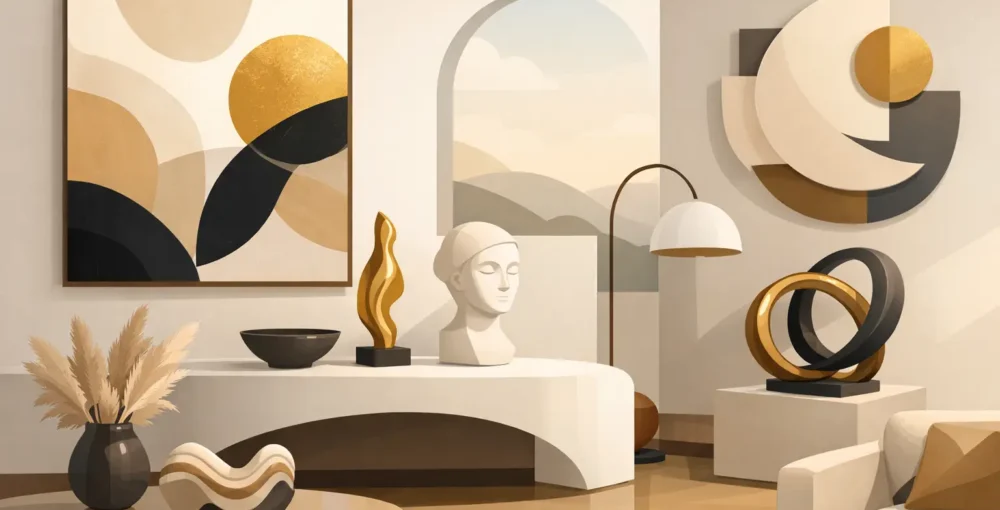
A room can be impeccably furnished and still feel anonymous. The difference is often a single object with enough presence to interrupt perfection: a bronze console whose surface holds the memory of the hand, a monumental lamp that changes the atmosphere after dusk, or a chair that reads as sculpture before it is ever occupied. The best luxury interior art pieces do more than complete a scheme. They give a residence its own visual language.
For collectors and architects, this distinction matters. Decorative accessories are selected to support a room. Interior art pieces can define it. They carry weight through form, material, scarcity, and authorship, creating a focal point that cannot be replicated by a familiar brand name or a well-styled arrangement.
What Makes a Luxury Art Piece Worth Living With?
Luxury is not a finish applied at the end of production. In its most convincing form, it begins with an idea and remains visible in every decision that follows: proportion, material selection, method of fabrication, and the discipline to produce only what deserves to exist.
A compelling interior art piece should feel resolved from every vantage point. Its silhouette may be quiet or dramatic, but it should not rely on novelty. Look for a tension between utility and expression. A table may have the presence of a carved monolith, yet still invite conversation around it. A mirror may distort reflection with a soft, organic perimeter, while retaining a sense of inevitability against the wall.
Rarity is equally significant. Limited editions and one-of-a-kind works have an authority that open-market furnishings cannot reproduce. Their value is not merely numerical. It lies in the knowledge that the object was conceived and made with intention, often through a dialogue between designer, artisan, and client.
Begin With the Architecture, Not the Empty Corner
The strongest acquisitions respond to a room’s existing character. Before choosing a sculptural object, study the space as an architect would: ceiling height, natural light, circulation, sightlines, acoustic softness, and the transition between adjacent rooms. A piece that appears extraordinary in isolation can lose its force if it competes with an ornate fireplace, disappears beneath a double-height ceiling, or restricts the natural movement through an entrance hall.
Scale is the first discipline. In a spacious living room, one substantial work often has more impact than several minor gestures. A low, elongated table can hold the center of a seating composition, while a large vertical lighting piece can draw the eye upward in a room with restrained architecture. Conversely, an intimate study may need an object with tactile complexity rather than physical volume: a finely worked side table, a singular wall relief, or a jewel-like lamp.
Negative space is not an omission. It is part of the composition. Allow a sculptural chair to be seen in profile. Give a freestanding console room to cast a shadow. A luxury interior should never feel like a gallery crowded at the opening night. It should allow each work to breathe.
The Best Luxury Interior Art Pieces by Role
Rather than buying by category alone, consider the role an object will play in the room. The most memorable interiors balance an anchoring work, a source of atmosphere, and smaller discoveries that reward attention.
Sculptural Furniture as the Anchor
A table, chaise, cabinet, or console can be the central art piece of a room because it occupies space with purpose. This is where functional design becomes especially powerful. A sculptural dining table, for example, receives daylight, florals, tableware, and the movement of people around it. Its material and profile are experienced repeatedly, not observed from a distance.
Curved forms are particularly effective in contemporary residences with hard architectural lines. They bring a sense of ease to stone, glass, and metal without weakening the room’s rigor. The trade-off is that organic furniture requires careful placement. Its outline should be legible, rather than pushed against competing geometries or lost beneath excessive styling.
Lighting That Becomes an Event
Lighting is among the most transformative forms of interior art because its identity changes throughout the day. In daylight, a hand-finished fixture is a sculptural volume. In the evening, it becomes a maker of mood, directing attention toward texture, revealing the depth of a surface, or giving a room a cinematic sense of enclosure.
Choose expressive lighting with restraint. A dramatic chandelier may be appropriate above a dining table or within a stair hall, but it needs a clear field around it. In a more intimate setting, a pair of sculptural lamps can establish rhythm while creating pools of warmth. The finest pieces never treat illumination as an afterthought. Their structure, shadow, and reflected glow are part of the work.
Objects With Material Presence
Small-scale objects can be decisive when their materials invite close attention. Hand-cast metal, carved stone, patinated surfaces, rare woods, and experimental composites create a physical intimacy that a purely visual object may not. These are pieces to encounter in the pause between conversations: on a console, beside a bath, at the threshold of a dressing room.
Avoid treating collectible objects as filler. A single unusual vessel or sculptural bowl is more persuasive than a collection assembled only to populate shelves. The object should hold its own against the architecture and retain its character without explanation.
Functional Rituals Reimagined
The private rooms of a residence offer some of the richest opportunities for artful design. A freestanding bathtub, a vanity, a screen, or a bespoke kitchen element can transform a daily ritual into an encounter with material and form. These works need more than visual drama. They must withstand touch, moisture, heat, and repetition without losing their composure.
This is where a maker’s technical command becomes essential. A beautiful piece that performs poorly will eventually feel indulgent in the wrong way. The ideal object is sensorial and durable, with a finish designed to age gracefully rather than remain artificially untouched.
Let Material Create a Conversation
A luxury interior gains depth when its materials have distinct voices. Veined stone brings geological history. Bronze introduces warmth and darkness. Lacquer can deliver controlled reflection, while a textured plaster or composite surface absorbs light and softens the room. The objective is not to use every desirable material, but to create relationships among them.
Contrast is often more compelling than coordination. A highly polished sculptural table can appear even more deliberate against matte walls. A tactile, hand-worked object can animate a restrained marble interior. Yet contrast needs a common thread, such as a repeated undertone, a shared curve, or an echo of the architecture’s proportions.
Material experimentation also deserves discernment. Novelty alone is temporary. Ask whether the material has been used in a way that honors its natural character, whether its finish will mature well, and whether it contributes to the emotional temperature of the room. The most successful pieces feel innovative without becoming dated by the next season.
Commissioning a Piece Changes the Entire Equation
A commissioned work makes particular sense when a room has unusual proportions, when a project requires a material not available in standard collections, or when privacy is central to the acquisition. It also allows an interior to move beyond the recognizable language of showroom luxury.
The process should begin with a precise conversation about the architecture and the intended experience. Is the object meant to command the arrival sequence, bring softness to a formal salon, or become a private pleasure within a master suite? What must it withstand? How should it feel under the hand? These questions lead to more meaningful design than a simple request for a particular color or dimension.
At Cedrimartini, the internal control of design and fabrication preserves this dialogue from initial sketch to final finish. For clients, that control offers more than customization. It offers discretion, consistency, and the confidence that the material language will be developed as a whole rather than assembled through disconnected suppliers.
A bespoke commission does require patience. Material testing, hand-finishing, and the refinement of prototypes cannot be compressed without consequence. The reward is an object that belongs to its setting so completely that it appears to have been imagined with the residence from the beginning.
Place Art Pieces With Curatorial Discipline
Placement determines whether an exceptional object feels inevitable or merely expensive. Begin with the main approach to the room. What is seen first from the doorway? What appears in reflection? What catches the eye from a seated position? The strongest piece is not always placed on the most obvious wall or in the geometric center. It is placed where its form can create a deliberate pause.
Resist matching every element. Two identical lamps may provide order, but a single sculptural work can bring more character to a room that is otherwise highly symmetrical. Similarly, a carefully chosen object may sit beside a painting without trying to imitate its palette or period. The connection can be emotional: both works share gravity, movement, or material intensity.
Finally, consider light as part of the placement. Direct sun can alter delicate finishes, while under-lighting can flatten texture. Test a piece in morning, afternoon, and evening conditions before finalizing its position. A work designed for a private interior should be lived with, not simply photographed.
The right acquisition is rarely the loudest one. Choose the piece that continues to reveal something after the first impression has passed: a change in surface under evening light, a curve that becomes more compelling in motion, or a material detail that makes the ordinary act of living feel considered.