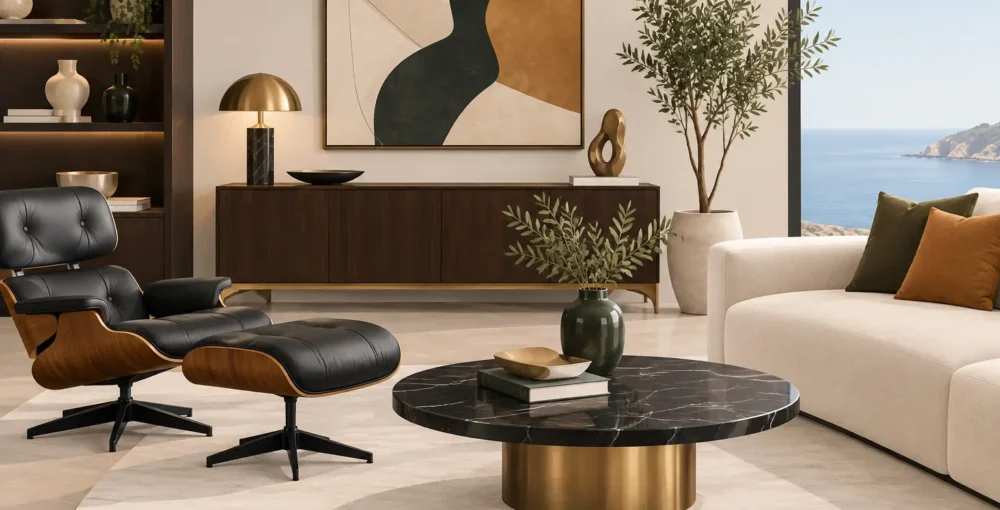
A curved console can appear effortless, almost inevitable, when it occupies the right room. Yet that quiet presence is usually the result of hundreds of decisions: proportion, grain direction, finish depth, structural engineering, and the discipline to remove every unnecessary gesture. This curated luxury furniture review considers what separates a genuinely collectible piece from an expensive object that merely performs luxury.
For private residences, boutique hospitality projects, and collector-led interiors, furniture is no longer chosen only to furnish a volume. It establishes a point of view. The strongest pieces carry visual authority without becoming theatrical, bringing atmosphere, material intelligence, and a distinct hand to rooms that cannot be repeated elsewhere.
What a Curated Luxury Furniture Review Should Examine
Price and rarity are not enough. A limited production number may create scarcity, but it does not automatically create cultural or aesthetic value. An informed review begins with the object itself: its silhouette, its construction, its relationship to the body, and the conviction behind its materials.
The first question is whether the design has an independent identity. A piece may reference an era, but it should not feel like a polished quotation from a familiar catalog. Collectible furniture earns its place when its lines remain compelling beyond the moment of purchase. Organic forms, for example, can bring softness to an architectural interior, but only when their asymmetry is controlled. Excessive gesture can date quickly. Restraint is often the more difficult achievement.
Material selection is equally revealing. Natural stone, cast metal, lacquer, hand-worked timber, glass, and experimental composites all possess their own visual language. The issue is not whether a material is rare, but whether it is used with purpose. A highly veined stone can dominate a room if it is paired with an equally expressive base. In another setting, that same stone may be precisely what is needed to animate a restrained palette. Luxury lies in judgment, not accumulation.
The Difference Between Fine Furniture and Collectible Design
Fine furniture is often defined by quality of execution. Collectible design asks more. It must carry an idea, a formal tension, or a material investigation that gives it a presence beyond utility. A table remains a table, but it can also become the gravitational center of a dining room. A seating piece can offer comfort while reading as a sculptural composition from every angle.
This distinction matters for collectors and design professionals building interiors with longevity. A well-made but conventional item may serve a project beautifully, particularly where visual calm is the priority. A collectible piece is selected when the room calls for authorship. It introduces a signature that cannot be substituted with a standard luxury offering.
That does not mean every room requires a statement. In fact, the most considered interiors reserve visual intensity for a few decisive moments. A monumental dining table may need quieter seating around it. A sculptural freestanding bath may ask for disciplined surfaces and controlled lighting. Curating luxury is as much about knowing what to leave silent as it is about choosing what will speak.
Provenance Is Part of the Object
Provenance is often discussed as a future resale consideration. It is more immediate than that. Knowing who conceived a piece, where it was fabricated, and how its materials were transformed gives the object a legible identity. In a market crowded with outsourced production and generic luxury language, a clear origin is a mark of substance.
The most compelling ateliers retain control over design and fabrication. This allows the designer’s intent to remain intact through prototype, revision, finishing, and final installation. It also provides a level of discretion that private clients and architects value when creating residences that are not intended to resemble published projects or showroom displays.
Cedrimartini works from this principle, treating furniture and sculptural objects as authored works shaped within its own Italian atelier. The result is not simply a product with a premium finish, but a piece whose character is protected from the earliest drawing to the final hand-applied detail.
Material Integrity Is Visible, Even at a Distance
A luxury piece should reward close inspection, but its integrity is often sensed before it is studied. The way light moves across a polished surface, the precision of a junction between stone and metal, or the subtle rounding of an edge all communicate care. These details affect how a room feels, even when guests cannot name exactly why.
Handmade work is not valuable because it is irregular for its own sake. Its value is found in controlled variation and human judgment. A hand-finished surface may reveal a depth that machine repetition cannot produce. A custom patina may shift under changing light. The artisan’s role is to bring character without compromising rigor.
Clients should also consider how materials will live. Unsealed porous stone can be seductive, but it requires an owner willing to accept patina and attentive care. Highly polished metal provides drama, yet records touch and movement more readily than a textured finish. Lacquer can deliver immaculate color, although it may demand more protection in high-traffic settings. These are not flaws. They are conditions of ownership, and an honest luxury recommendation makes them clear.
Bespoke Work Changes the Standard of Review
Ready-made collectible furniture is judged by what it is. Bespoke furniture must also be judged by the quality of its process. The finest result is not achieved by asking a client to select from a long menu of options. It emerges through an exacting conversation about architecture, light, circulation, use, and the emotional register of a home.
A commissioned dining table, for instance, should be considered in relation to the approach into the room, the scale of the chairs, the height of nearby sightlines, and the habits of those who gather around it. A small adjustment to the thickness of a top or the spread of a base can transform the piece from merely impressive to perfectly resolved.
Customization is most successful when it preserves the identity of the design. There is a point at which adding finishes, details, or decorative requests weakens the original concept. A confident atelier will guide the commission rather than simply agree to every intervention. That discipline protects both the client and the work.
Privacy Is a Luxury Service, Not an Added Feature
For many high-net-worth clients, the commission process is personal. It may concern a new residence, a private retreat, or a property whose interiors are never intended for public view. The ability to develop a singular piece discreetly, with a small and accountable creative team, is central to the value of an atelier relationship.
This is especially relevant for architects and interior designers working on residences where every visual decision must remain confidential until completion. Production control, careful communication, and direct accountability reduce the uncertainty that can accompany high-value custom work. They also allow the project to retain its sense of rarity.
How to Judge a Piece in Its Intended Setting
Before acquiring a major object, view it against the room’s actual conditions whenever possible. Ask how it performs in daylight and evening light. Consider its shadow, not only its form. Think about the approach from adjacent spaces, because a sculptural object is often first encountered in motion rather than head-on.
Scale should be judged generously. An object that appears substantial in a gallery may feel slight in a double-height space, while a compact form with a strong silhouette can command an intimate room. Measurements are essential, but they cannot replace a sense of visual weight. Stone, dark metal, and saturated finishes tend to read heavier. Pale timber, glass, and open structures may read lighter even at substantial dimensions.
There is also a practical question: does the piece support the life of the space? A collector’s object need not be fragile, but it should be placed with intention. A low sculptural table in a family room may be entirely appropriate if its finish is selected for daily use. In a formal salon, a more delicate surface may be the right choice. The distinction is not between beauty and function. It is between a piece chosen for its true context and one chosen only for an image.
The Lasting Test of Curated Luxury Furniture
The most persuasive furniture does not ask for constant attention. It holds its place through proportion, material depth, and an unmistakable sense of authorship. Months after installation, it should continue to reveal a line, texture, or shadow that was not noticed at first encounter.
For collectors, homeowners, and designers, the useful question is not whether an object looks luxurious on arrival. Ask whether it will make the architecture around it feel more intentional, more personal, and more complete. When the answer is yes, the piece has moved beyond furnishing and become part of the residence’s private legacy.