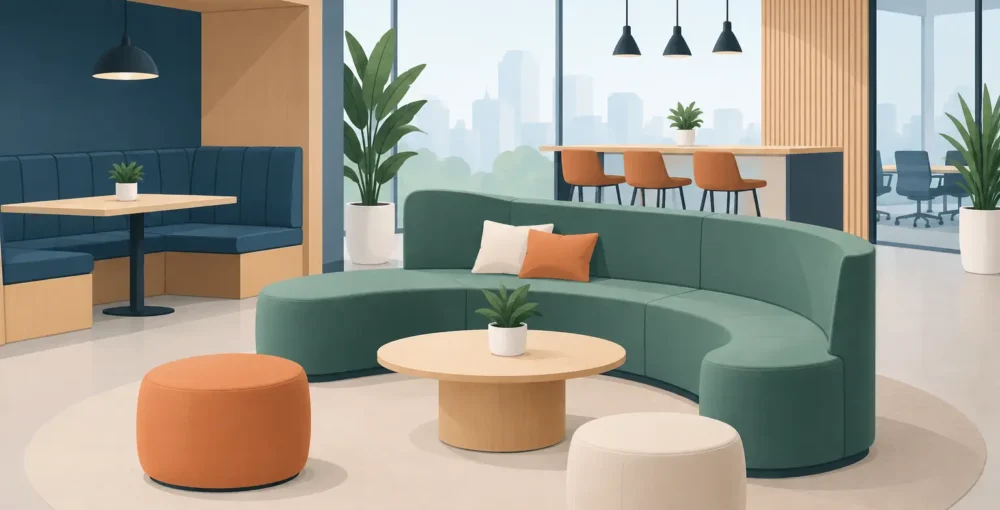
A room can be impeccably furnished and still lack a point of gravity. Often, that missing element is seating conceived not as an item to place, but as an architectural gesture to inhabit. Knowing how to integrate custom seating begins with this distinction: a commissioned sofa, chaise, bench, or occasional chair should establish a relationship with the room’s volumes, light, materials, and rituals rather than simply fill an available footprint.
For a private residence, yacht, hospitality suite, or gallery-like reception area, bespoke seating offers something standard furniture cannot: authorship. Its scale can answer an unusual ceiling height. Its profile can follow the curve of a wall or frame a view. Its finish can carry the mineral depth, tactile warmth, or quiet luminosity already present in the interior. The result is not more furniture. It is a more resolved environment.
Start With the Room’s Architecture
The most successful custom seating is decided long before upholstery, wood, or metal is selected. Begin by reading the room as a composition. Consider the width of passages, the position of openings, the height of the eye line when seated, and the direction in which daylight travels across the surfaces.
In a large living room, a low, expansive sofa can give generous volume a human scale. In a more intimate salon, one sculptural loveseat or curved banquette may have greater presence than a conventional three-piece arrangement. The question is not how many seats the plan can accommodate. It is what form gives the room its proper rhythm.
Custom work is especially valuable where architecture resists standardized dimensions. A window bay, a circular stair hall, a recessed library, or a long wall beneath art may call for seating that follows a precise geometry. Here, a built-to-measure piece can look inevitable rather than inserted. Its lines belong to the space because they were conceived with it.
Circulation deserves equal attention. A dramatic chaise that interrupts the route from entrance to terrace loses its authority, however beautiful its silhouette. Allow movement to remain graceful and unforced. In entertaining spaces, seating should invite small gatherings without turning every conversation into a formal arrangement.
How to Integrate Custom Seating Around Daily Rituals
Luxury is not expressed by visual impact alone. It is expressed by the ease with which a space supports the life lived within it. Before commissioning custom seating, define the rituals it must hold: private reading, late evening conversation, a family gathering, a client reception, or a moment of solitude beside a fire.
A formal drawing room may favor upright proportions, a composed backrest, and a configuration that permits guests to face one another. A media room requires another kind of intelligence: depth, support, acoustic softness, and a sight line calibrated to the screen. In a primary suite, an upholstered bench can become a quiet threshold between dressing and rest, while a curved window seat creates a private observatory rather than an additional surface.
Comfort should be specified with unusual honesty. A seat designed primarily for visual drama can be intentionally firm, upright, or shallow. That may be right for a foyer, a collector’s salon, or a restaurant lounge where turnover matters. It is less appropriate for a room intended for hours of relaxed use. The finest commissions do not pretend that one posture serves every occasion. They give each setting its own physical character.
This is also the moment to decide whether seating should command attention or recede into a larger composition. A singular, hand-shaped armchair can act as a sculptural object against restrained architecture. Conversely, in an interior already animated by exceptional stone, art, or panoramic views, the seating may need to offer visual calm while retaining depth in its materials and craftsmanship.
Let Material Create Continuity
Materials make the difference between a custom piece that belongs and one that merely coordinates. Rather than matching every surface, seek a considered dialogue. The pale veining of a stone floor might be answered by plaster-toned upholstery. A bronzed metal detail on the staircase may reappear as a subtle base or inset. Walnut can lend depth to a room of pale limestone; lacquer can introduce a controlled reflection beside matte walls.
Texture is equally powerful. Bouclé, brushed wool, saddle leather, silk velvet, woven natural fiber, or a hand-finished composite each changes how seating is perceived at close range. A room with hard architectural finishes often benefits from upholstery with visible softness. Yet contrast should be used with discipline. Too many expressive materials can make a room feel curated in fragments rather than composed as a whole.
Custom seating also permits material transitions that standard collections rarely offer: leather flowing into timber, cast metal meeting hand-worked upholstery, or a mineral surface forming an integrated side plane. These junctions carry the character of the piece. They should be treated as moments of craftsmanship, not hidden technical necessities.
At Cedrimartini, the atelier approach allows form and fabrication to develop together, so material is never an afterthought applied to a finished design. That internal control is particularly meaningful when a commission calls for experimental finishes, organic curves, or a rare balance of tactile and sculptural presence.
Use Scale to Create Presence, Not Excess
There is a temptation to equate bespoke furniture with monumentality. In reality, the most persuasive custom seating may be remarkably restrained. Presence comes from proportion, silhouette, and placement, not simply from size.
A deep sofa with a floating base can appear lighter than a smaller, boxier model. A rounded back can soften a rectilinear room without asking for attention. A pair of chairs may create greater ceremonial weight than a larger sectional if their forms are placed with intention and given sufficient breathing room.
Consider the negative space around each piece as carefully as the seating itself. In a room where every perimeter is occupied, even extraordinary objects lose their distinction. Allow a sculptural chair to be seen in the round when possible. Give a curved banquette enough clear floor around it to reveal its contour. In a compact room, one exceptional piece is often more luxurious than several competing gestures.
Proportion also includes the pieces surrounding the seating. Coffee tables should sit at a height that serves the seat, not merely follows a trend. Rugs should ground the arrangement without making it feel trapped. Lighting should reveal texture and contour after dusk, particularly where curved forms create shadows that evolve across the evening.
Commission for Longevity, Not a Momentary Look
A bespoke piece carries responsibility. It should feel distinctive now without becoming captive to a fleeting visual language. This does not mean avoiding character. It means rooting character in enduring elements: impeccable construction, finely judged proportions, honest materials, and a form that has a reason to exist.
The practical brief should be precise. Share architectural drawings, finish samples, photographs taken in changing light, and an understanding of who will use the space. Discuss maintenance requirements early, particularly for pale textiles, natural leather, exterior conditions, or residences used seasonally. A material that develops patina may be deeply desirable in a private study and entirely unsuitable for a high-traffic hospitality setting.
Privacy is another part of a true bespoke process. For clients whose homes, collections, or development projects require discretion, the commission should be managed with quiet clarity from initial concept to fabrication and installation. The confidence to share references, measurements, and personal habits often leads to a design that is more individual and more exact.
When custom seating is given the authority of architecture, it changes more than the room’s appearance. It gives daily life a place to gather, pause, and be remembered – a reason to sit longer and notice what has been made for no one else.