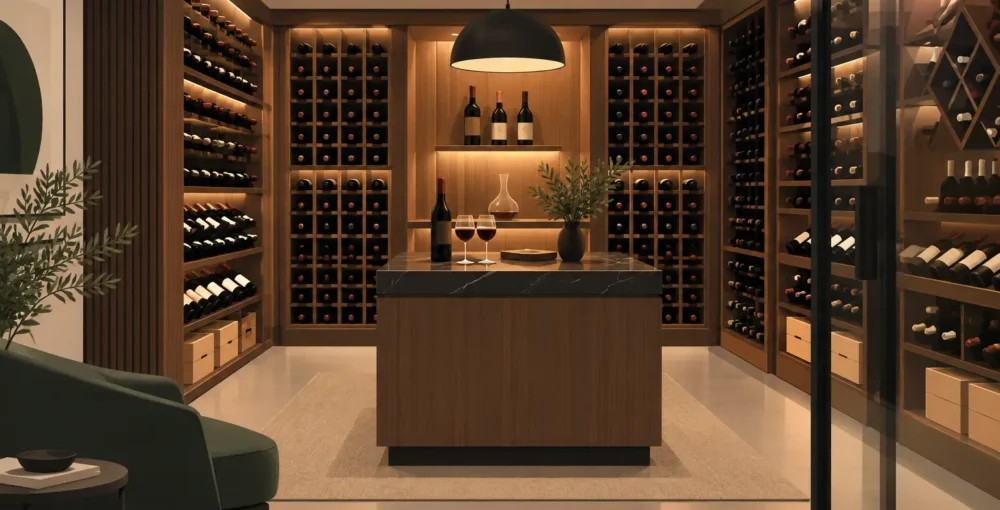
A serious collection should not disappear behind a utility door. Bespoke wine rooms give rare bottles a setting equal to their provenance: intimate, precisely composed, and designed to heighten the quiet ceremony of choosing, opening, and sharing a remarkable vintage. For the private collector, the room becomes more than controlled storage. It becomes part of the home’s cultural landscape.
This distinction matters. A standard wine cellar answers a practical requirement, often with rows of predictable racking and a technical appearance. A commissioned wine room can do more. It can hold the atmosphere of a library, the material depth of a private gallery, or the sculptural tension of a contemporary salon, while respecting the conditions a collection requires.
Bespoke Wine Rooms Begin With the Collection
No two collections ask for the same architecture. The client whose cellar is built around mature Bordeaux and Burgundy will require a different rhythm from one acquiring Champagne in large formats, Italian wines for long-term aging, or a focused selection intended for immediate enjoyment. Quantity matters, but it is not the only measure. Bottle dimensions, rotation habits, presentation preferences, and the ritual surrounding service should all shape the commission.
A room for 500 bottles may be deliberately spare, with each label afforded visual space. A room for several thousand may call for a more layered order: archive storage behind, an accessible daily selection at hand, and a small group of exceptional bottles presented as objects in their own right. The finest scheme never treats capacity as an abstract number. It gives the collection a legible hierarchy.
The collector’s habits define the room
The first design conversations should consider how the room will be inhabited. Is it a private retreat for a single collector, a setting for intimate dinners, or a destination within a larger entertaining suite? Will bottles be selected by the owner, a sommelier, or household staff? Does the collection need to remain discreet, or is its presence intended to animate the architecture?
These questions influence every later decision. A tasting table may become the room’s center of gravity. A concealed service counter may be more appropriate in a formally restrained residence. In another project, a glazed wine room beside a dining space can become a luminous architectural element, provided privacy, light control, and temperature management are resolved with rigor.
Architecture Before Decoration
The most persuasive wine rooms never feel as though decorative cabinetry has been added to a technical enclosure. Their material language grows from the architecture itself. Curved walls can soften the geometry of bottle storage. Recessed niches can create a measured cadence across a long elevation. A hand-finished portal can make entry feel ceremonial without becoming theatrical.
This is where bespoke work has a lasting advantage. Rather than forcing a room into a fixed modular system, the design can respond to ceiling heights, irregular plans, historic details, stone vaults, or the precise proportions of a new-build residence. A narrow under-stair volume can become a jewel-like cabinet. A generous basement can be transformed into a sequence of rooms, moving from protected storage to tasting and display.
The technical envelope must be considered from the beginning, not concealed as an afterthought. Insulation, vapor control, refrigeration equipment, glazing, door seals, and air movement all affect the long-term stability of the collection. Conditions vary with the wines, the local climate, and the room’s relationship to the rest of the house. A specialist climate consultant should be involved early, allowing the interior to maintain its composure while the environmental infrastructure performs quietly in the background.
Material as Atmosphere
A wine room is one of the few interiors in which material can be both sensorial and protective. The cool gravity of stone, the warmth of darkened timber, the reflectivity of metal, and the tactile irregularity of hand-applied surfaces each alter the experience of the bottles within.
Timber remains compelling, but it need not be predictable. Ebonized oak, smoked walnut, or richly figured species can be shaped into shelving with depth and shadow rather than conventional racking. Patinated bronze introduces a subtle gleam that changes as the room is entered. Mineral plaster, hand-worked stone, and specially developed surfaces can bring a more monolithic presence, allowing the bottles to appear almost excavated from the architecture.
Material selection also involves restraint. Highly porous finishes, overly perfumed woods, or treatments that cannot tolerate a controlled cellar environment may be unsuitable. The most luxurious answer is not always the most elaborate one. It is the one in which every surface has been selected for its visual character, tactile quality, and endurance.
At Cedrimartini, this process is approached as an alchemical laboratory of form and material. The aim is not to apply luxury as a finish, but to compose an interior in which handcraft, proportion, and rare surfaces create an unmistakable identity.
Light Should Reveal, Not Expose
Wine rooms are often compromised by lighting that treats bottles as retail merchandise. A private collection deserves a more nuanced approach. Light should lead the eye through the space, reveal the grain of a crafted shelf, and give a selected label its moment without flattening the room into glare.
Concealed linear illumination can articulate the depth of niches. Low, warm pools of light can define a tasting table or sculptural central island. Carefully aimed accents can bring drama to a small group of significant bottles, magnums, or decanters. The palette should remain controlled, and ultraviolet exposure must be addressed so that visual display does not come at the expense of the wine.
The best lighting schemes preserve mystery. From outside the room, one may glimpse a glow, a silhouette, the quiet repetition of bottle forms. Within it, the atmosphere should invite pause rather than demand attention.
Display, Storage, and the Value of Discretion
There is a useful tension at the heart of bespoke wine rooms: a collection may be deeply personal, yet visually powerful enough to become an architectural statement. The resolution lies in deciding what should be seen and what should remain protected.
Open display is ideal for bottles chosen for regular enjoyment or for a tightly edited group with exceptional labels and provenance. Deeper storage can remain concealed within paneled walls, behind sculptural doors, or in lower-temperature reserve zones. This layered approach prevents the room from feeling crowded and offers practical order as the collection evolves.
For clients who value privacy, opacity may be part of the beauty. Solid doors, limited glazing, hidden access, and discreet inventory areas allow the wine room to remain an interior known only to those invited inside. In a residence where security is a consideration, such decisions should be integrated into the design language rather than announced by it.
A Commission Built Around Permanence
A bespoke wine room is not a purchase made from a catalog. It is a collaboration between client, architect, interior designer, climate specialists, and makers. The process should begin early enough that services, structure, access, and finishes can be coordinated without compromise.
For new residences, this allows the room to be conceived as part of the home’s original architecture. In renovations, it calls for an honest reading of constraints: ceiling clearances, existing moisture, structural walls, equipment locations, and delivery routes. These realities do not diminish the creative opportunity. They give the design its discipline.
The value of an atelier-led commission lies in authorship and control. When design development, prototyping, material research, fabrication, and finishing are closely held, the final room can possess a continuity rarely achieved through assembled components. Curves align with joinery. Metal meets stone with intention. Hardware, shelving, and thresholds speak the same visual language.
A wine room should ultimately feel inevitable within its setting, as though the residence had always been waiting for it. Let the collection lead the commission, then allow craftsmanship to give it a room worthy of the stories still waiting to be uncorked.