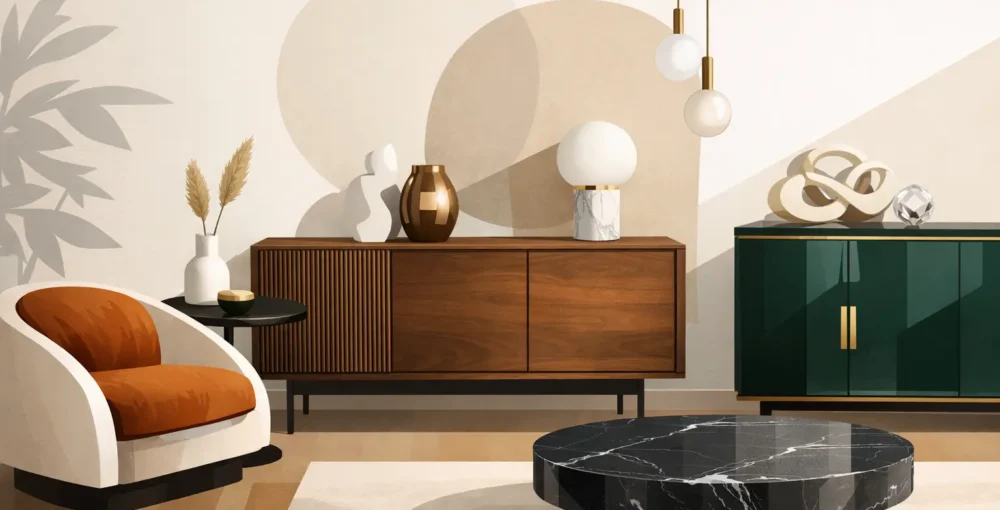
A statement piece is not made memorable by scale alone. Its surface determines whether a sculptural console holds the room with quiet authority, whether a dining table feels ceremonial, and whether a chair reads as collectible design rather than merely expensive furniture. The best finishes for statement furniture give form a second life: they catch light, invite touch, deepen over time, and make an object feel impossible to replace.
For private residences, boutique hospitality, and singular architectural interiors, finish selection should begin with a simple question: what should this piece make people feel when they enter the room? The answer may be restraint, drama, warmth, or a sense of discovered rarity. Material and finish translate that feeling into a physical presence.
Why Finish Carries the Identity of a Piece
A finish is not decoration applied at the end of production. In exceptional furniture, it is part of the design language from the first sketch. The same curved silhouette can appear monolithic in mineral plaster, luminous in high-gloss lacquer, intimate in hand-oiled wood, or almost geological in patinated bronze.
This is particularly true for organic forms. Curves create shifting planes, and shifting planes reveal a finish differently throughout the day. A hand-worked surface may appear matte from one angle and subtly burnished from another. A lacquered volume can hold reflections like still water. These changes prevent a statement object from becoming static.
The right choice also depends on proximity. A monumental cabinet viewed from across a salon can support a dramatic, reflective finish. A bedside table or vanity, encountered at arm’s length every day, benefits from sensorial warmth and an intelligent tolerance for touch. Luxury does not require fragility, but it does require honesty about how a material will live.
The Best Finishes for Statement Furniture
Hand-patinated metal
Patinated bronze, brass, and other metals bring immediate gravity to furniture. Their appeal lies in variation: a hand-applied patina settles into recesses, moves across curved edges, and produces depth that cannot be replicated by a uniform industrial coating. Depending on the recipe, the result can be smoky brown, near-black, burnished gold, oxidized green, or richly umber.
This finish is especially compelling for consoles, low tables, sculptural seating, and cabinet fronts where the metal is allowed to read as a continuous skin. It pairs beautifully with travertine, dark timber, and softly textured plaster, providing a disciplined contrast to pale, mineral interiors.
Patina is not for clients seeking visual sameness. Minor tonal shifts, subtle marks, and gradual evolution are part of its value. Protective treatments can control sensitivity, yet the most beautiful patinated pieces retain a sense that the atelier’s hand remains visible beneath the surface.
Deep lacquer, from mirror gloss to velvet matte
Lacquer remains one of the most expressive finishes for statement furniture because it can turn an object into pure color and light. A deep oxblood, ink blue, tobacco, ivory, or custom mineral tone can make a simple silhouette feel cinematic. High-gloss lacquer amplifies curves and reflects the surrounding architecture, while a super-matte lacquer gives color a velvety, almost tactile density.
Gloss is powerful in rooms with deliberate sightlines and controlled lighting. It is ideal for a collector’s cabinet, a curved bar, or a side table intended to punctuate a restrained space. Its trade-off is practical: highly reflective surfaces reveal dust, fingerprints, and fine surface marks more readily than lower-sheen alternatives.
Matte lacquer is quieter but no less luxurious. It suits private dressing rooms, library furniture, and sculptural storage where color should absorb light rather than compete with art, stone, or textiles. A refined matte surface requires equally refined application. Flatness, consistency, and a precise edge profile separate a true atelier finish from an ordinary painted one.
Stone with a honed or leathered surface
Stone brings an elemental quality that few materials can match. For statement furniture, honed marble, onyx, travertine, quartzite, and richly veined natural stone have the authority of landscape compressed into an architectural object. A rounded stone table or monolithic basin does not need ornament. Its veins, fossils, pores, and tonal movement provide the narrative.
A polished stone surface offers clarity and light, particularly in dramatic marbles or translucent onyx. A honed finish is more contemplative, softening reflection while preserving the stone’s depth. Leathered and brushed textures intensify tactility and can make an oversized piece feel less formal, especially when paired with warm wood or aged metal.
The choice should account for use. Dining and occasional tables require thoughtful sealing and an understanding that acidic spills can affect some stones. In a collector’s interior, this is not necessarily a flaw. A discreet trace of life may be welcome. In a heavily used hospitality setting, a denser and more forgiving stone may be the wiser expression of luxury.
Hand-finished wood and ebonized timber
Wood introduces a human scale to dramatic design. Its grain provides warmth against metal, stone, glass, and lacquer, while hand-finishing gives a surface the depth that factory stains often erase. Fumed oak, smoked ash, ebonized oak, walnut, and brushed timber can all create powerful statement furniture without relying on obvious shine.
An oil or wax finish allows the grain to remain legible and tactile. It is particularly suited to dining tables, sculptural benches, and cabinets whose generous curves invite the hand. The surface can be renewed over time, an advantage in homes where furniture is intended for daily life rather than preservation behind a rope.
Ebonized timber offers a more formal register. It reads nearly black but preserves enough grain to avoid the flatness of opaque paint. Used with bronze details or pale stone, it creates a composed, architectural tension. In darker rooms, however, an ebonized piece needs considered lighting so its silhouette does not disappear.
Textured plaster and mineral composite
For interiors that favor sculptural calm over overt ornament, textured plaster and mineral composite finishes are exceptional. Their appeal is not perfection but atmosphere. Fine irregularities, soft trowel marks, and a chalky light absorption give furniture the presence of a small architectural volume.
These finishes work beautifully on plinth tables, consoles, sideboards, and sculptural storage. They are especially convincing in spaces with limewashed walls, pale stone floors, or quiet tonal palettes, where a glossy surface might feel too assertive. The best examples possess depth rather than a merely rough texture, with layers of color and handwork that reveal themselves slowly.
Because edges and frequently touched areas can be vulnerable without appropriate protection, the construction beneath the finish matters. At Cedrimartini, material experimentation and fabrication are held within the same atelier, allowing the finish, substrate, and intended use to be considered as one composition rather than separate decisions.
Choosing a Finish in Context
The most successful finish is rarely chosen in isolation. Consider the room’s daylight, the temperature of its existing materials, and the object’s role. A single reflective object can animate a matte interior. Several reflective surfaces can create visual noise. A dark patina may give a pale room needed weight, while a pale mineral finish can relieve a room already rich with walnut, brass, and patterned textiles.
Scale matters as much as palette. Strong veining that is enchanting on a small pedestal may overwhelm a large dining table. Conversely, a nearly uniform finish may look elegant on a cabinet but feel underwhelming on a two-meter sculptural table. Requesting physical samples, viewed in the actual room at different times of day, is not an excess. It is the proper way to judge a finish whose character depends on light.
There is also a distinction between a finish that photographs well and one that lives well. If children, guests, or frequent entertaining are part of the setting, choose materials that can be maintained with confidence. If the piece is intended as a singular art object in a private gallery-like environment, a more delicate finish may be entirely appropriate. Rarity has different meanings in different rooms.
A statement piece deserves a surface with its own point of view. Choose the finish that makes the form feel inevitable, then give it the light, space, and care required to reveal its character over years rather than moments.