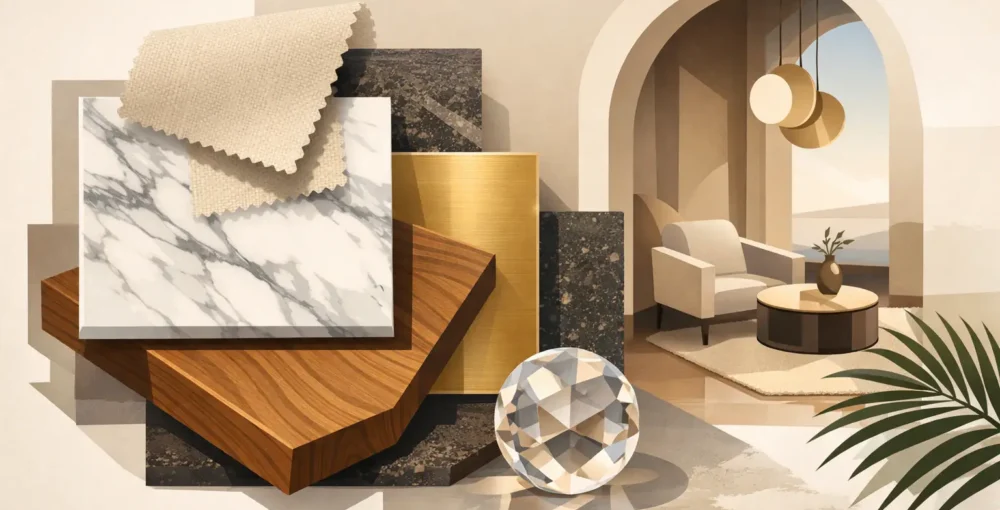
A hand-finished surface can change the entire emotional temperature of a room. It can catch the low winter light of a London residence, soften the geometry of a Manhattan penthouse, or lend a secluded coastal retreat the quiet authority of an art collector’s home. Custom materials for luxury interiors are not decorative additions applied at the end of a project. They are often the first and most consequential decision: the material language from which proportion, atmosphere, and permanence emerge.
For clients who have already encountered the familiar vocabulary of premium stone, lacquer, bronze, and timber, rarity alone is no longer enough. What matters is authorship. A surface should hold evidence of the hand, respond to the architecture around it, and possess a character that cannot be replicated through a catalog selection. This is where material becomes an expression of private taste rather than a marker of generic luxury.
Why Custom Materials Change a Luxury Interior
A bespoke interior is defined less by the number of expensive elements it contains than by the relationships between them. The pale mineral depth of a custom plaster may make a curved sofa feel more sculptural. A patinated metal insert can draw out the warm vein in a rare stone. A lacquer developed in a particular tone may give a room a sense of stillness that a standard finish cannot achieve.
These are subtle decisions, but they carry enormous visual weight. Off-the-shelf materials arrive with a predetermined identity: a fixed color, grain, sheen, and scale. Custom material development begins with a more intelligent question: what should this room make its owner feel?
The answer may call for a wall finish with the soft irregularity of weathered limestone, a glossy resin that appears almost liquid beneath light, or a composite surface embedded with pigment and mineral fragments. The material is composed not merely to fill an area, but to create a particular presence.
For a private residence, this level of specificity can make the difference between a beautifully furnished space and one that feels impossible to reproduce. In hospitality, it allows a suite, spa, or reception space to establish a distinct identity without relying on obvious gestures. The most memorable interiors tend to be those in which the materials carry the narrative quietly.
The Difference Between Rare and Truly Bespoke
A rare material is not automatically a bespoke one. An exceptional slab of marble, an antique timber beam, or a limited quarry stone may be difficult to source, yet its appearance remains largely predetermined by nature or provenance. Its scarcity has value, but it does not necessarily respond to the architecture, the client, or the object it will become.
A truly bespoke material is developed through intention. Its depth, texture, reflectivity, edge treatment, color saturation, and tactile response are calibrated for a specific context. The process may involve tests of mineral powder, hand-applied pigment, metal oxidation, cast resin, layered lacquer, leather, ceramic, or reclaimed natural matter. It is an alchemical laboratory in which the expected behavior of a material is examined, challenged, and refined.
This does not mean every surface must announce itself. In fact, restraint is often the greater luxury. A custom material can appear almost austere from a distance, revealing its complexity only on approach: a faint metallic movement beneath a dark finish, a changing density of grain, a matte surface that absorbs light rather than reflecting it. Such details reward proximity and time.
The Value of Irregularity
Industrial production is designed to eliminate variation. An atelier understands that controlled variation can be the source of beauty. The slight shift in a patina, the hand of a polished edge, and the natural movement within a cast surface give a piece a visual life that perfect repetition cannot provide.
This distinction is especially important in sculptural furniture and architectural elements with curved organic forms. A material must follow the gesture of the form rather than sit on it like a skin. When developed correctly, the surface and silhouette appear inseparable, as though each could only exist because of the other.
There is, however, a balance to maintain. Too much variation can compete with a room’s art, view, or architectural detail. A disciplined maker knows when to make the material expressive and when to let it become a refined field for the life around it.
Custom Materials for Luxury Interiors Begin With Context
The strongest commissions do not begin with a swatch. They begin with the setting: the quality of daylight, the scale of the room, the adjacent materials, the client’s collections, and the way the space will be inhabited. A dramatic blackened finish may have great impact in a high-ceilinged gallery-like room, but it can feel oppressive in a low, shaded interior. A high-gloss surface may lend energy to an evening space while becoming too active beside a bright south-facing window.
Material selection must also consider touch. A dining table, vanity, headboard, door pull, and sculptural screen all meet the body differently. The cool density of stone can be ideal for a bathroom plinth, while a hand-finished timber or leather may bring necessary warmth to the point where one rests a hand. Luxury is not only what the eye recognizes. It is what the body remembers.
At Cedrimartini, the value of working as both designer and maker lies in this continuity. The object can be conceived around the behavior of its chosen material from the beginning, rather than translated later through separate suppliers. That internal control protects the integrity of the original idea while allowing for the trials, adjustments, and discoveries that distinguish an authentic bespoke process.
Light Is a Material Partner
No material is seen in isolation. Daylight, candlelight, recessed illumination, and evening shadow all alter its character. A bronze-toned finish may read as warm and inviting at dusk, then reveal cooler mineral notes in daylight. A pale textured wall can create an almost atmospheric effect as light moves across its relief.
For this reason, samples should be judged in the actual environment whenever possible. A small panel beneath a studio light cannot fully predict how a finish will perform against expansive glazing, a historic ceiling, or a carefully considered lighting scheme. Full-scale mockups are not a luxury excess. For significant surfaces, they are a form of due diligence.
The Discipline Behind Material Experimentation
Material experimentation has a romantic reputation, but the finest results depend on rigor. A finish must be beautiful, yet it must also suit its purpose. A surface intended for a private bar has different requirements from one intended for a wet room, exterior terrace, or frequently used dining setting. Resistance to moisture, heat, ultraviolet light, abrasion, and cleaning agents must be considered without compromising the intended expression.
This is where trade-offs become essential. A more delicate hand-applied finish may offer incomparable depth but require thoughtful care. A highly resilient surface may be more practical for a family residence or hospitality project, though its visual softness may differ from an artisanal counterpart. Neither choice is inherently superior. The right choice depends on use, setting, and the client’s willingness to preserve the material’s intended patina over time.
Patina itself deserves respect. In many luxury interiors, the desire for immaculate permanence can obscure the pleasure of graceful aging. Natural leather deepens, untreated metal evolves, and timber acquires a richer expression through touch and light. When these changes are anticipated rather than feared, an interior gains history instead of simply accumulating wear.
A Private Signature, Not a Passing Statement
Trends often favor surfaces that photograph instantly: exaggerated veining, mirror-like gloss, theatrical color, or overtly distressed texture. They may be appropriate when they genuinely serve the architecture. Yet the most enduring custom material programs are not designed for immediate recognition alone. They are designed to remain compelling after the novelty has passed.
That endurance comes from proportion, depth, and restraint. It comes from choosing a finish that belongs to the building, not merely to a moment in design culture. It also comes from reserving intensity for the places where it matters most: a monumental fireplace, a curved kitchen island, a dressing room cabinet, a bath surround, or a singular sculptural object that anchors the room.
A bespoke material need not appear everywhere to define an interior. Often, one exceptionally resolved surface creates a thread that can be echoed in smaller details: a metal inlay, a lighting base, a furniture edge, or a custom jewel-like handle. Repetition becomes a private code, perceptible to those who know where to look.
The most rewarding place to begin is not with what is currently available, but with what the architecture and its inhabitants ask for. Give the material enough attention to become part of the original vision, and it will do more than finish a room. It will give the room its unmistakable identity.